The first lesson in Timothy Snyder’s On Tyranny is four words long: do not obey in advance. “Most of the power of authoritarianism is freely given,” Snyder writes. In bad times, people and institutions think ahead to what a more repressive government will want, and offer it without being asked. A government that has to force every concession is weak. A government that can count on its targets to surrender before the fight begins does not need to be strong at all.
This series is about the institutions that gave it freely: the ones whose whole value rested on their independence, and who traded that independence away before any court made them. It starts with the law firms, because the law firms are the cleanest experiment anyone could design. The same President signed the same kind of order against the same kind of firm in the same few weeks. Some firms paid. Some fought. We now know how both choices turned out.
The template
On March 6, 2025, President Trump signed an executive order against Perkins Coie, the firm that represented Hillary Clinton’s 2016 campaign. The order was a template for the ones that followed. It stripped the firm’s lawyers of their security clearances, restricted their access to federal buildings and officials, and directed agencies to review the government contracts of the firm’s clients: in other words, it told every company that does business with the federal government that hiring this firm could cost them.
Perkins Coie went to court. Six days later, on March 12, Judge Beryl Howell blocked most of the order from taking effect.
That date matters, because of what happened next.
Six days
On March 14, two days after Perkins Coie’s first win, Trump signed a nearly identical order against Paul, Weiss, Rifkind, Wharton & Garrison. The stated grievance was a former partner, Mark Pomerantz, who had left the firm years earlier to work on the Manhattan District Attorney’s investigation of Trump’s finances.
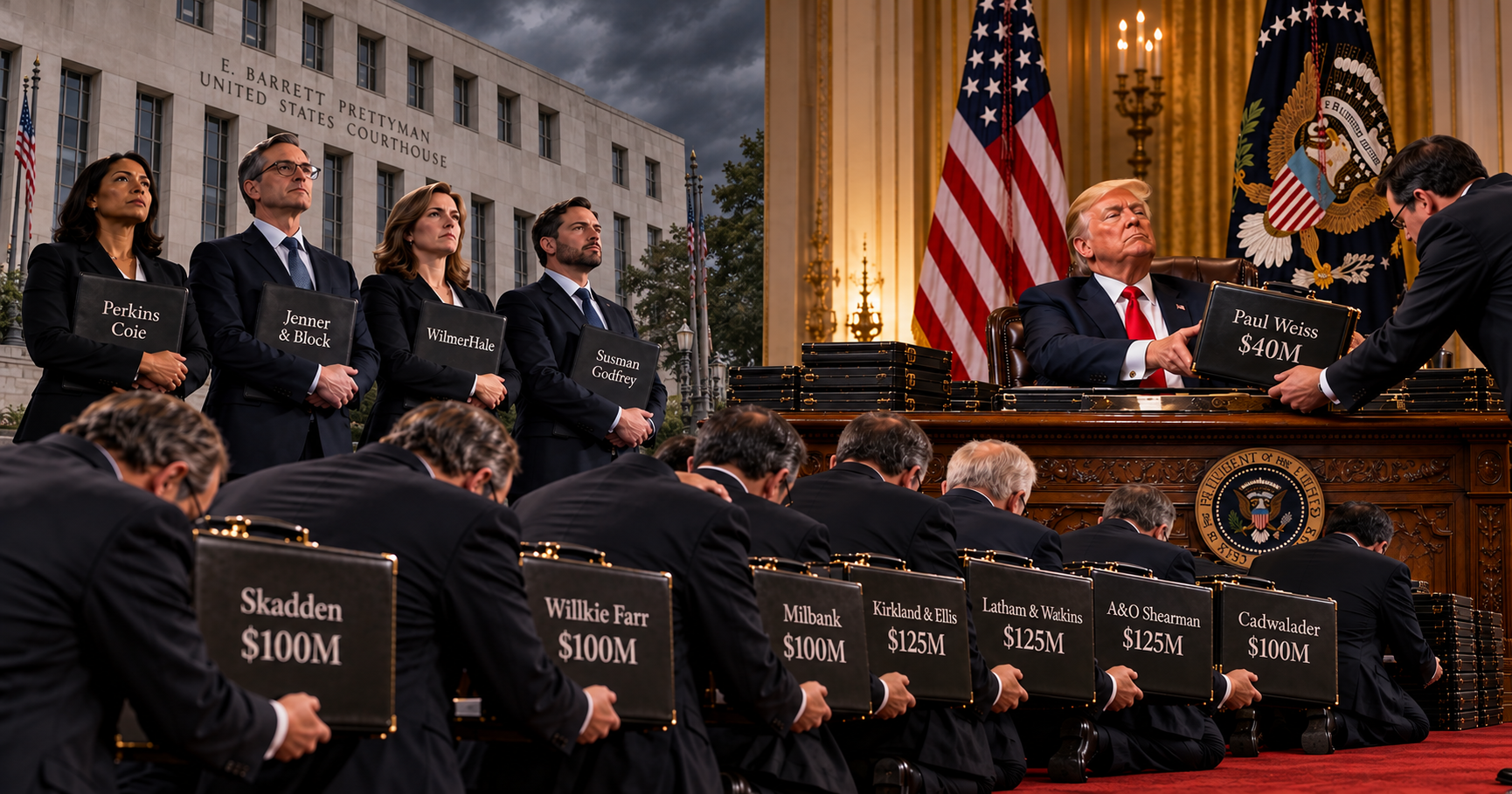
Paul Weiss did not sue. Its chairman, Brad Karp, went to the White House. On March 20, six days after the order was signed, Trump rescinded it. In exchange, Paul Weiss agreed to provide the equivalent of $40 million in free legal work for causes the administration supports, and to drop diversity considerations from its hiring. In Trump’s telling, Karp also acknowledged “the wrongdoing” of Pomerantz. Karp later described the order as an “existential crisis” for the firm.
Consider what Paul Weiss knew when it made that deal. It knew the order’s terms were copied from one a federal judge had blocked the week before. It knew that judge had found Perkins Coie’s challenge strong enough to block the order before a full hearing. It employed some of the best litigators in the country, the kind of lawyers corporations hire precisely because they do not fold under government pressure. And it folded anyway, in the same six days it had taken Perkins Coie to win.
Paying without being asked
Paul Weiss at least had an order against it. What came next is the purest case of obeying in advance the legal profession has produced.
On March 28, Trump announced that Skadden, Arps had agreed to provide at least $100 million in free legal work. No order had been signed against Skadden. The firm made the deal to ward off one, and by one account it approached the administration first. Willkie Farr and Milbank followed with their own $100 million commitments. On April 11, five more firms joined them: Kirkland & Ellis, Latham & Watkins, A&O Shearman, and Simpson Thacher at $125 million each, and Cadwalader at $100 million.
Not one of those eight firms had an executive order signed against it. All eight paid anyway. Counting Paul Weiss, nine firms pledged about $940 million in free services.
What did they buy? The terms were vague from the start, and the President made clear he regarded the money as his to direct. “I think we’re going to try to use these very prestigious firms to help us out with the trade,” he said at a Cabinet meeting the day before the April deals were announced. Some firms have since insisted their deals exclude that kind of work; what the pledged hours have actually gone to has stayed murky. That murk is the point. A firm that has publicly agreed to owe the President nearly a billion dollars in services, on terms he gets to interpret, has not settled a dispute. It has accepted a standing obligation to a political patron, and every client it represents against the government now has reason to wonder which side its lawyers are on.
Fighting
Four firms took the other path. Perkins Coie kept litigating. Jenner & Block and WilmerHale, each hit with an order in late March, sued. Susman Godfrey, targeted in April, sued too.
All four won. On May 2, 2025, Judge Howell permanently struck down the Perkins Coie order, calling it an “unprecedented attack” on foundational principles of the American legal system. She noted that the order drew on a playbook as old as Shakespeare’s “The first thing we do, let’s kill all the lawyers,” and that it took the “cringe-worthy” approach of “Let’s kill the lawyers I don’t like.” Later that month, Judge John Bates struck down the Jenner & Block order and Judge Richard Leon struck down the WilmerHale order “in its entirety as unconstitutional.” On June 27, Judge Loren AliKhan permanently blocked the Susman Godfrey order as “unlawful retaliation” for activity protected by the First Amendment.
Four judges. Four separate cases. Appointees of both parties. Not one of them found the orders defensible.
The government’s own conduct since then suggests it has reached the same conclusion. On March 2, 2026, the Justice Department asked the appeals court to dismiss its appeals of all four rulings. Less than a day later, it reversed itself and asked to keep fighting, explaining only that it was the department’s “prerogative” to change its mind. When the consolidated appeal was argued before the D.C. Circuit on May 14, the panel sounded skeptical of the government’s central argument, that targeting the firms was an unreviewable national-security judgment. The American Bar Association filed a brief on the firms’ side. As of this writing, the appeals court has not ruled. But so far, every court to rule on these orders has sided with the firms that fought.
What paying cost
The firms that settled would say they were being prudent: that a fight was expensive and uncertain, that their clients could not afford to be caught in the crossfire, that a deal made the problem go away. The record does not support any of it.
The fight was not uncertain. Perkins Coie had already won its first round before Paul Weiss signed anything. The problem did not go away; it turned into a debt of hours, owed to the President, on terms he defines. And the eight firms that paid without being targeted did not make a problem go away at all. They created a precedent: that the country’s most powerful law firms will hand over nine-figure sums on the strength of a rumor. Every pressure campaign that followed, against universities and media companies, was launched by a President who had already learned that.
That is what Snyder means by power freely given. The executive orders against law firms were, as four federal judges have now held, unconstitutional. On their own, they could have been a brief and embarrassing episode: a few orders struck down, a few firms vindicated, a clear signal that this was a line the government could not cross. What turned them into a successful strategy was not the government’s power. It was the firms that obeyed before they had to.
The rest of this series looks at other institutions that faced the same choice: universities, and the companies that own America’s news networks. Some of them paid, and some of them fought. The pattern holds.