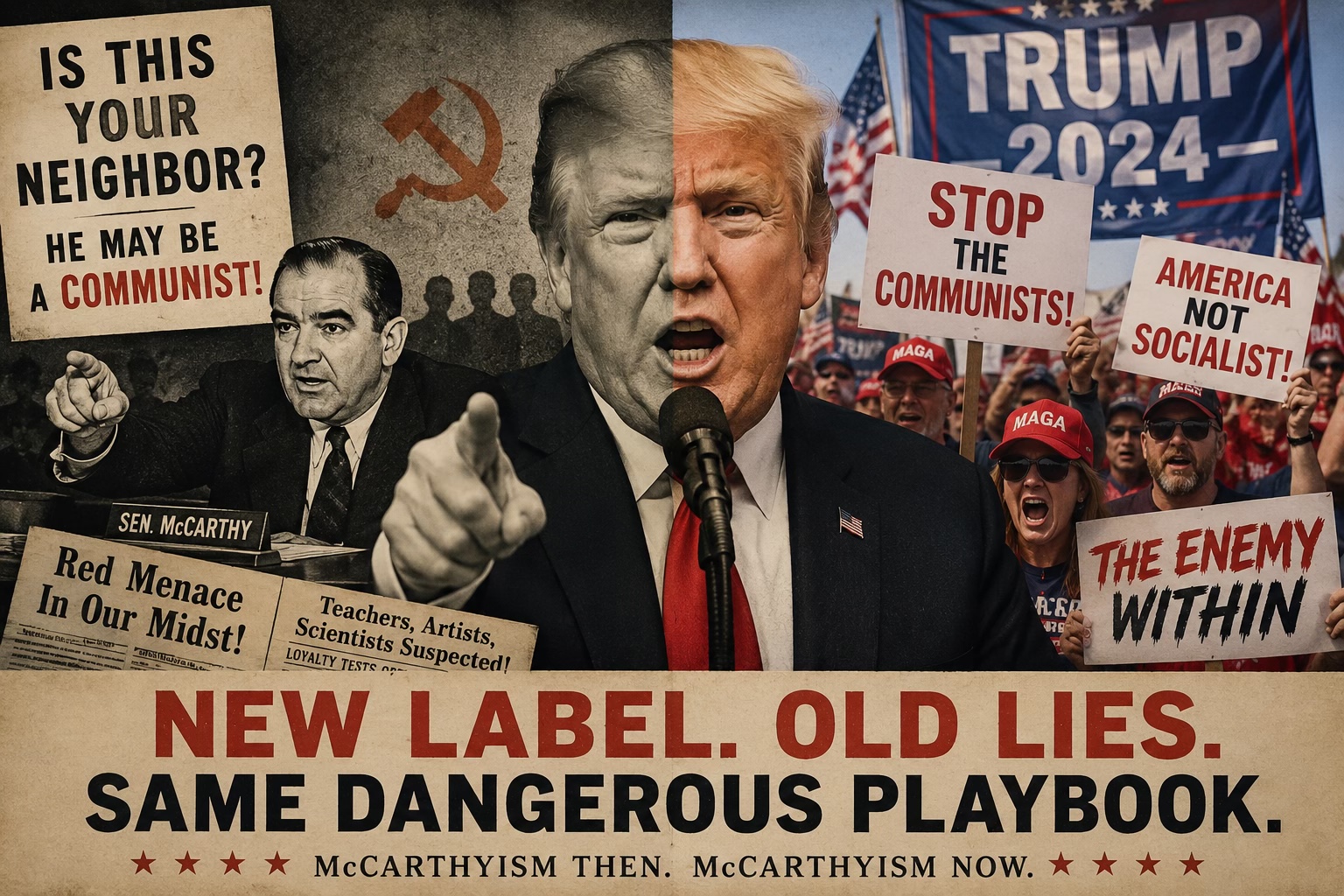
Every generation convinces itself that it is immune to the mistakes of history. Then someone rediscovers an old playbook, changes a few labels, and millions cheer as if it’s an exciting new idea.
Donald Trump and much of the MAGA movement have spent years resurrecting one of America’s most destructive political traditions: the anti-communist hysteria of the 1950s.
Not actual communism.
The rhetoric.
The language.
The habit of treating political disagreement not as disagreement but as evidence of treason.
President Trump drove the point home again this week at Mount Rushmore, warning that America faces a “renewed attack” from a “communist menace” and calling communism a “mortal threat” to the nation.
Nobody should object to criticizing communism. The Soviet Union was a brutal dictatorship responsible for enormous human suffering. Mao’s China produced one of history’s worst famines. North Korea remains one of the world’s most repressive states.
That isn’t the issue.
The issue is what happens when “communist” stops describing an actual political ideology and starts functioning as an all-purpose insult for anyone the government dislikes.
That is exactly what happened during the Second Red Scare.
Senator Joseph McCarthy became famous by claiming, in a speech infamously titled “Enemies Within,” that he possessed lists of communists secretly infiltrating the federal government. Careers were destroyed. Artists were blacklisted. Teachers, scientists, and civil servants found themselves forced to prove they weren’t disloyal. Thousands of innocent Americans paid the price for a moral panic that eventually became synonymous with reckless accusation and political persecution.
The parallels today are difficult to ignore.
Political opponents are routinely labeled Marxists.
Universities are portrayed as nests of radical subversion.
Journalists become enemies.
Civil servants become members of a so-called “deep state.”
Even the phrase “the enemy from within”—a phrase Trump has repeatedly used when describing political opponents—echoes the language of internal subversion that dominated Cold War America.
The irony is almost painful.
The original anti-communist movement claimed to defend freedom while often undermining it through censorship, loyalty tests, blacklists, and suspicion. The danger was never merely communism itself; it was allowing fear to become an excuse for abandoning liberal democratic principles.
History eventually judged McCarthyism harshly not because Americans stopped opposing Soviet communism, but because they recognized that democratic societies cannot survive if every political disagreement becomes evidence of disloyalty.
The modern version follows the same script.
Healthcare reform becomes socialism.
Environmental regulation becomes Marxism.
Universities become indoctrination camps.
Career civil servants become saboteurs.
Political opponents become existential threats rather than fellow citizens.
Once every disagreement is portrayed as a battle against communism, compromise becomes surrender and elections become wars for national survival.
This is how democracies begin viewing themselves through the lens of permanent internal conflict.
Perhaps the most striking aspect of this revival is how disconnected it is from reality.
The United States does not face a serious communist movement capable of overthrowing capitalism. The Cold War ended more than three decades ago. The Soviet Union no longer exists. Even countries governed by communist parties often operate extensive market economies.
Yet the language survives because it serves a political purpose.
Calling someone “communist” is easier than engaging with their arguments.
It transforms ordinary policy disputes into moral absolutes.
It tells supporters that the opposition isn’t merely wrong—they’re fundamentally alien to America itself.
That may be effective politics.
It is terrible civic culture.
The tragedy is that America has already lived through this story once.
We know where paranoia leads.
We know what happens when accusations replace evidence.
We know that defining fellow Americans as enemies rather than citizens corrodes the institutions that hold a democracy together.
History doesn’t repeat itself exactly.
But sometimes it reaches into an old filing cabinet, dusts off a familiar script, and hands it to a new cast of politicians.
The costumes have changed.
The slogans have changed.
The target list has changed.
The playbook hasn’t.