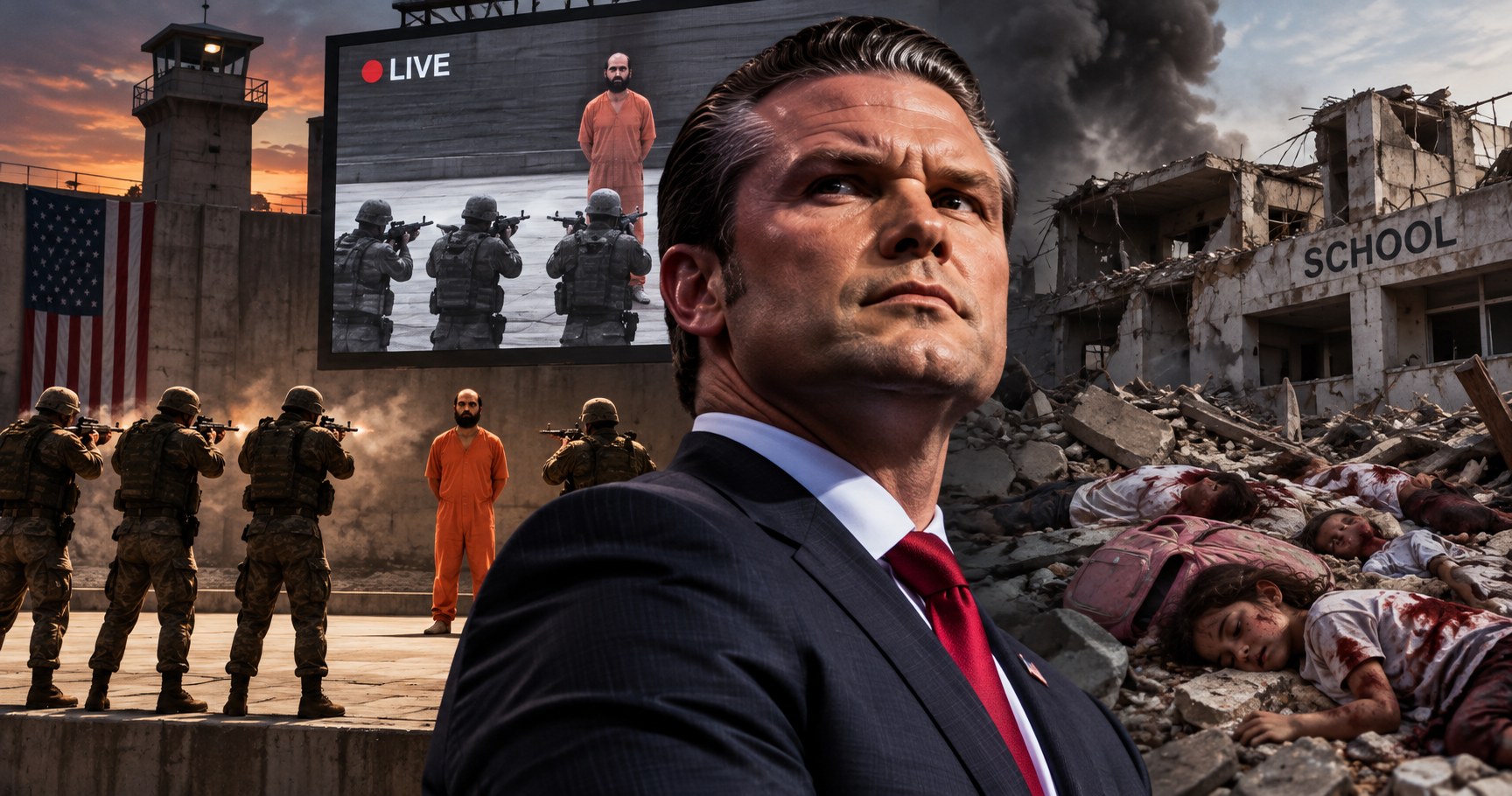
On December 3 at 1 p.m., the hour Nidal Hasan opened fire at Fort Hood in 2009, soldiers plan to execute him there by firing squad. Hasan murdered 13 people and wounded 32 more. His death sentence came from a military court, and the president approved it. Whatever you think of capital punishment, that part is not the scandal.
The scandal is the audience. Asked about the execution last week on Real America’s Voice, Hegseth promised: “We’ll make sure that people are able to watch it, that it’s public.” The Pentagon then confirmed it will be livestreamed. Asked whether Hasan had made any final requests, Hegseth answered: “Don’t care. We’ll see him on December 3rd.” He picked the hour to match the crime, and he reached back to World War II for the method.
The United States has not held a public execution since 1936. The last one, a hanging in Owensboro, Kentucky, drew a crowd of thousands and a carnival atmosphere that shamed the country out of the practice. The president has since condemned Iran for its public executions. His secretary of defense now wants to stage one of our own, on a schedule, with a stream link.
Every secretary of defense is in the business of violence. That is the job, and pretending otherwise is its own kind of dishonesty. But there is a difference between a man who accepts killing as the grim price of national security and a man who seems to relish saying the word. More than a year and a half into Pete Hegseth’s tenure, the record makes clear which kind we have.
The vocabulary of appetite
Start with what he says, because he says it often and he says it proudly. At Quantico in September 2025, having summoned hundreds of generals and admirals from around the world, Hegseth promised “no more politically correct and overbearing rules of engagement,” just “maximum lethality.” He described the department’s philosophy as unleashing “overwhelming and punishing violence on the enemy.” He told the assembled officers, “You kill people and break things for a living.” Lethality, he said, “is our calling card.”
Rules of engagement are not political correctness. They are the accumulated lessons of a century of war about who may be killed, when, and why: the mechanism by which a professional military distinguishes itself from an armed mob. A defense secretary who frames them as an obstacle is not describing a policy. He is describing a frustration. In the same speech, he said that all he ever wanted as a young platoon leader was to have his hands untied. He is now, in effect, the platoon leader for the entire United States military, and the hands are untied.
He was back at Quantico on September 30 of this year for what he says will be an annual “State of the Force” address. He bragged about the generals he had pushed out and the culture-war fights he had won, and attendees went home with a 144-page bound collection of his speeches. Fox News, his former employer, didn’t carry it. He took no questions. By then he had not briefed Pentagon reporters on the Iran war since early May.
Three days later, he took the same message to cadets at the Air Force Academy. He listed “the cartel drug boat strikes” among the operations he was proudest of, right alongside the Iran war. He told the cadets they would have “all the authorities you could ever conceive you would need,” and boasted that commanders tell him they have never had “more unleashed rules of engagement.” He boiled the doctrine down to a slogan: “Clear mission, full hearts, maximum authorities.” In the entire speech, he did not mention civilians once.
Minab
The rules of engagement he mocks have a purpose. They exist to keep soldiers from killing people they shouldn’t.
On February 28, in the opening hours of the war with Iran, a missile destroyed a girls’ elementary school in Minab, next to an Iranian naval base. About 175 people died, most of them children, according to Iranian officials. A preliminary military investigation found the United States responsible, the New York Times reported.
Four days into that war, Hegseth stood at a Pentagon podium and boasted that troops had “maximum authorities granted personally by the president and yours truly,” and that the rules of engagement were built “to unleash American power, not shackle it.” Asked about the school, he said only that it was under investigation. The Economist has since reported that he cut the Pentagon’s civilian-harm assessment staff, the people whose job is to flag when a target has become dangerous to civilians, by roughly 90 percent.
I can’t prove that any one of those decisions killed those children. No one can yet; the investigation is ongoing. But a secretary who spends years telling the force that restraint is weakness, and then dismantles the office that practices restraint, doesn’t get to be surprised when restraint fails.
At the Air Force Academy, Hegseth also explained his “War Department golden rule”: lead every formation the way you would want your own children led. “My sons and daughters are no more special than any other sons or daughters,” he said, “made in the image and likeness of God.” It is a good sentence. It should apply to the girls in Minab, and to the two men clinging to the wreckage on September 2. In his account of these wars, it never does.
The boats
Words would be just words if not for what followed them.
On September 2, 2025, the U.S. military struck a small boat in the Caribbean that the administration said was carrying drugs. The strike did not kill everyone. Two men survived, clinging to the wreckage of a vessel that one lawmaker who later viewed the video described as capsized and clearly incapacitated. The military struck again and killed them.
The Washington Post reported that Hegseth gave a spoken directive to kill everyone aboard. Hegseth called the reporting “fabricated.” Then the White House confirmed the follow-up strike and attributed it to Adm. Frank “Mitch” Bradley, acting under Hegseth’s authorization. Then Hegseth said he had watched the first strike live but didn’t “stick around” for the next one, while insisting Bradley had made “the correct decision.” The story moved from it didn’t happen, to it happened but not on my order, to it happened and it was right. What never moved was the conclusion that two men in the water deserved to die.
And as the controversy peaked, the secretary of defense posted an image of Franklin the Turtle (a children’s book character known for kindness) firing on drug boats from a helicopter, captioned “For your Christmas wish list.” The publisher condemned it. The Pentagon’s chief spokesman mocked the publisher.
It is worth sitting with that. Facing credible reporting that his department killed shipwrecked survivors, the man responsible chose to make a joke of it, using a children’s character, timed for the holidays. Policy can be argued in good faith. That cannot.
The campaign continued. By late May of this year, the Associated Press counted at least 199 people killed in strikes in the Caribbean and eastern Pacific. Only three people are known to have survived a strike and been rescued. The administration has not publicly presented strike-by-strike evidence that the people killed were smugglers, let alone the “narco-terrorists” Hegseth vowed to “track,” “hunt,” and “kill,” treating them, in his words, “EXACTLY how we treated Al-Qaeda.” Smuggling drugs is a crime. In this country, we used to try people for crimes.
The casualties he expects
The same casualness extends to Americans. When an Iranian projectile got through air defenses in March and killed six U.S. service members in Kuwait during Operation Epic Fury, Hegseth explained that every so often one gets through: “we call it a ‘squirter.’” A week later he told 60 Minutes that “things like this don’t happen without casualties,” and that there would be more.
Both statements are technically true. Wars kill people, including our own. But notice the register. The deaths of six Americans became an occasion for jargon; the prospect of more became an occasion for resolve. There is no weight in it. For a man who calls lethality the military’s calling card, casualties are inventory.
What “blood lust” means here
I am not claiming Hegseth personally enjoys watching people die. I don’t know what is in his heart, and neither does anyone else. The charge is narrower and, I think, worse: that he has made killing the measure of success rather than the cost of it. That he treats restraint as weakness, law as an obstacle, and dead men in the water as content.
Defense analysts have made the strategic version of this case. Lethality cut loose from strategy is precisely the lesson of Iraq and Afghanistan (the wars Hegseth himself fought in), where we killed enormous numbers of people and still did not win. A military that counts bodies instead of outcomes has been tried before. Body counts were how we were winning in Vietnam, too.
The moral version is simpler. The American tradition of civil-military relations rests on the idea that violence is controlled by law and discipline. That is what separates a soldier from a killer. Hegseth’s project, stated openly and repeatedly, is to loosen that control. He calls it a warrior ethos. It is an appetite in uniform.
The defense, and why it fails
The administration’s case deserves a hearing. Cartels kill Americans with fentanyl in numbers that dwarf these strikes. The president has constitutional authority to defend the country. Sen. Tom Cotton watched the September 2 video and called the strikes “entirely lawful.” The Pentagon inspector general found the military followed its established targeting process. Hegseth says Iran hid weapons near schools and hospitals. And Nidal Hasan is a mass murderer who has had more due process than any of his victims got.
But the inspector general explicitly did not evaluate whether the boat strikes were legal, only whether the military followed its own targeting procedure. Congress never authorized a war on drug smugglers, and Republican Rep. Thomas Massie has filed articles of impeachment charging that Hegseth carried out hostilities against Iran without congressional approval. The claim about Iranian human shields has come without public evidence; the Pentagon declined to provide any when the Times asked. And nothing about Hasan’s guilt requires a livestream. Justice does not need an audience. A secretary confident in the law would show the evidence instead of a cartoon, and carry out a lawful sentence without a broadcast.
The point
Hegseth has denied wanting to run for president in 2028. He doesn’t need to. He has already reshaped the department around a single idea: that the purpose of the American military is to kill, that anything slowing the killing is the enemy, and that killing is something to be shown off. A cartoon turtle for the boats. “Maximum authorities” for Iran. A livestream for Fort Hood. Every general pushed out, every rule waved away, every civilian-harm planner let go moves the institution further from what it was built to be.
The men on that boat on September 2 were already beaten. Their boat was gone. They were in the water. Someone decided that wasn’t enough. Whatever the Pentagon called that decision, the rest of us should call it what it is.