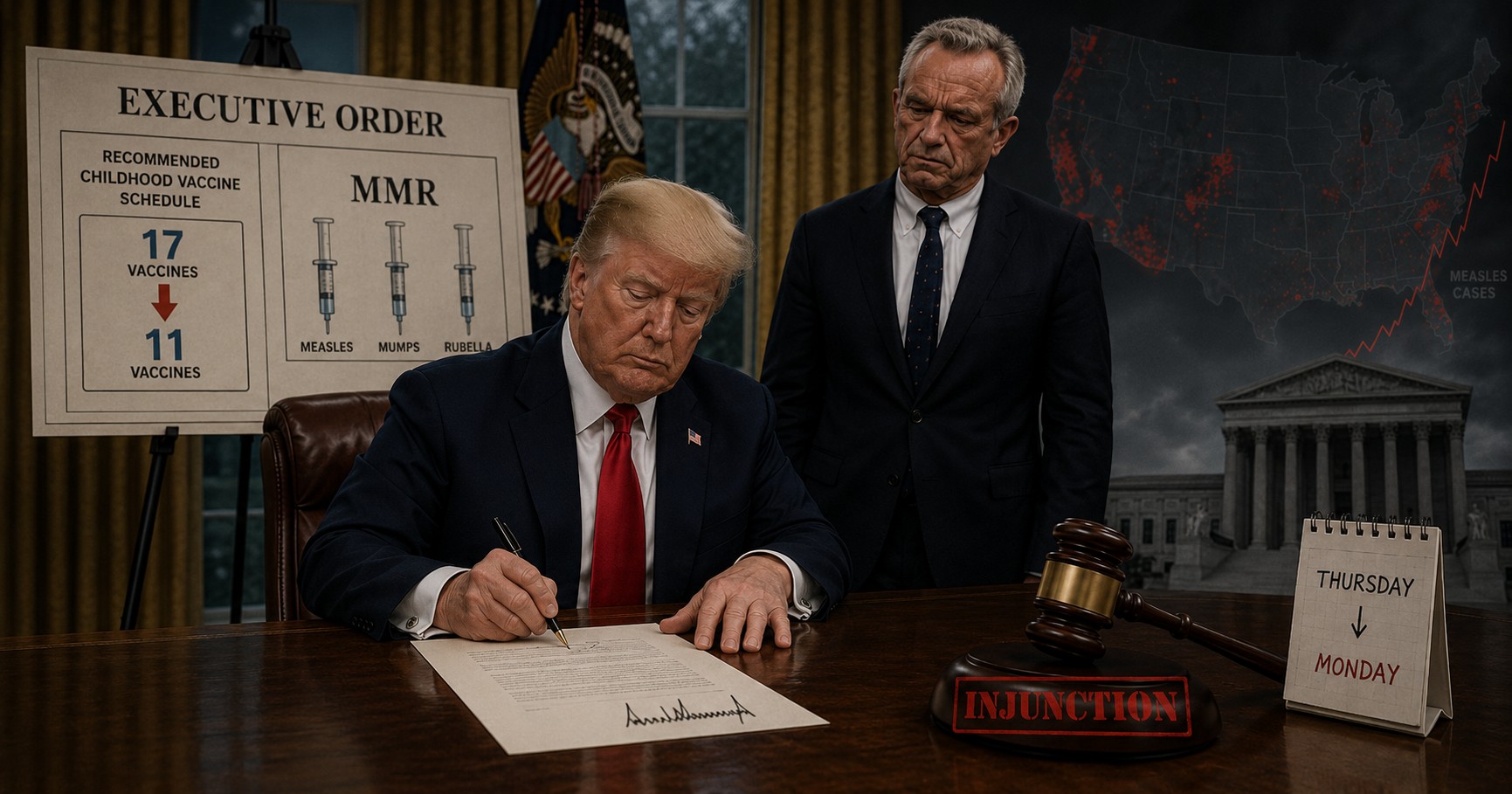
On Monday, August 10, President Trump signed an executive order titled “Delivering Gold Standard Childhood Vaccine Recommendations for Americans.” It directs the CDC to cut the recommended childhood vaccine list from 17 diseases to 11 and to break the combined measles-mumps-rubella shot into three separate injections. Robert F. Kennedy Jr. stood next to him as he signed it.
This publication reported four days earlier that the White House was “actively weighing an executive order on vaccines and autism, possibly within the week.” It was not a hard call to make. The order was the next entry in a sequence this publication has been tracking since Kennedy’s confirmation, and it arrived on schedule.
At the signing, Trump tied the order directly to autism, a link that dozens of peer-reviewed studies have found no evidence for. He went further than the written order itself, calling the combined MMR shot “lethal” and claiming the combination of vaccines “can be explosive,” claims with no basis in the medical literature. “This updated recommendation finally aligns the United States with other advanced and developed nations,” he said, an assertion CNBC found misleading: most peer nations recommend a comparable or larger number of childhood vaccines, just administered on a different schedule.
The order is not merely aimed at bad optics. It runs directly into a federal court that already ruled on this exact question. In March, U.S. District Judge Brian Murphy found that Kennedy’s earlier attempt to cut the schedule and stack ACIP with his own appointees violated federal law, and stayed both. That injunction is still in effect. Richard Hughes IV, the attorney representing the American Academy of Pediatrics in that case, said the new order encourages “the same unlawful changes” to the schedule that Murphy already blocked. “In that sense, it flies in the face of the judge’s order in our case,” Hughes said.
Vaccine law specialist Dorit Reiss cautioned that the order itself carries no direct legal force. “This should have no direct operational effects,” she said, since the CDC, not the president, sets federal vaccine recommendations. But she added that Trump “has influence,” and that the order is likely to intensify political pressure on states to loosen their own school vaccination requirements regardless of what the CDC’s schedule technically says. An order with no legal teeth can still move policy by making defiance of it politically costly, the same mechanism behind the Texas subpoena this publication covered days earlier.
The medical response was immediate. AAP president Dr. Andrew Racine called the timing itself dangerous: “As measles cases reach a 35-year high in the U.S. and with cold and flu season quickly approaching, today’s executive order on vaccines is not only disheartening but dangerous,” he said, adding that “the science of vaccines and their efficacy has not changed.” He also flagged a practical harm buried in the order’s spacing-out requirement: more required visits means more time parents have to take off work to get their children vaccinated at all. That 35-year high is not rhetorical. The CDC had confirmed 2,318 measles cases this year as of late July, the most since 1991, with 93 percent of infections in people who were unvaccinated.
None of this is happening in a vacuum. It is the same administration that, days before this order, was subpoenaing AAP itself over the position it is now defending in federal court, the same administration whose handpicked CDC director testified under oath that she was fired for refusing to pre-approve conclusions before seeing the evidence behind them. December 2024, this publication called Kennedy’s coming approach to public health “America’s Lysenko,” a rejection of evidence in favor of ideology, backed by state power. The comparison did not need updating for this order. It only needed the next data point, and the White House supplied one four days after the last.