Daniel Ellsberg was once denounced as a traitor. Today he is remembered as the man who exposed government deception during the Vietnam War. History has an odd habit of rehabilitating the people who were punished at the time for telling an uncomfortable truth. It is worth asking, while it is still happening, who this administration is punishing right now, and for what.
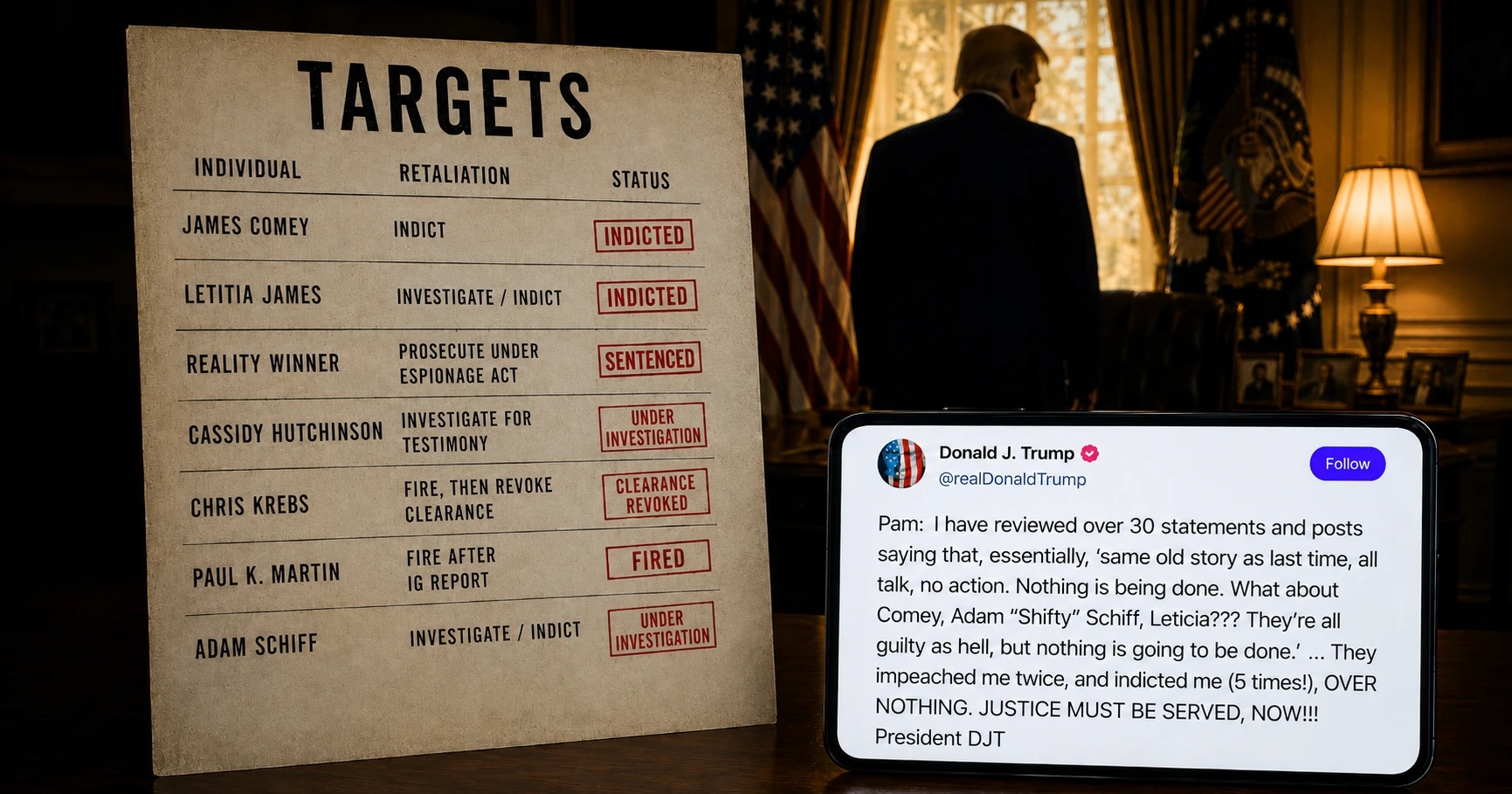
The list is no longer short enough to call it coincidence. The Philadelphia Inquirer has tracked at least 470 targets of retribution in the first year of this term, an average of more than one a day. On the Senate floor, Sheldon Whitehouse said roughly 20 of the 60 people FBI Director Kash Patel named as “deep state” enemies in his own book have already faced some kind of adverse action since Patel took over the bureau. Not everyone on either list is a whistleblower. But a striking number of them are: people whose only offense was telling the public, a court, or Congress something true that this administration would rather they hadn’t.
This publication has already traced how the administration dismantled the government’s other independent checks: the inspectors general, the science advisory boards, the Foreign Service promotion standards, the military’s own lawyers. This is about something narrower and more personal: the specific people inside that system who told a specific, sourceable truth, and paid for it individually. Here are eight of them.
The Leak
In 2017, Reality Winner, an Air Force veteran and NSA contractor, leaked a single classified report to The Intercept describing how Russian military intelligence hacked a U.S. company that sold voter-registration software, then used the stolen credentials to target 122 local election officials before the 2016 election. She did not sell secrets. She exposed evidence that a foreign adversary had targeted American democracy. For that, she received the longest sentence ever imposed for leaking classified information to the press: five years and three months.
Nine years later, the same law is being used the same way. In April 2026, the Justice Department charged Courtney Williams, a former civilian employee at Fort Bragg, under the Espionage Act for allegedly telling a journalist about misconduct inside a secretive Army special-operations unit. She faces up to ten years. FBI Director Kash Patel called her arrest a message to “any would-be leakers.” That message carries further now that Attorney General Pam Bondi has rescinded the policy shielding journalists from leak-related subpoenas, a change the FBI used within months to search the home of a Washington Post reporter.
The Witness
Cassidy Hutchinson testified to the January 6 committee about what she witnessed inside the Trump White House, including the president’s furious reaction when told he could not join the crowd marching to the Capitol. When Joe Biden issued preemptive pardons on his way out of office, shielding Liz Cheney, Mark Milley, and Anthony Fauci from prosecution, Hutchinson was not on the list. Three years later, the Justice Department is pursuing her over that testimony, at the urging of the House GOP’s own January 6 panel, which claims she lied under oath. Attorney General Pam Bondi opened the investigation in April 2026; Trump fired her weeks later anyway, reportedly for being too slow to prosecute his perceived enemies. Her successor, now-Attorney General Todd Blanche, has since personally pushed prosecutors to build the case anyway. The allegation against her is, in essence, that she told the truth about it too accurately.
The General
After U.S. strikes on Iranian nuclear sites in 2025, President Trump said the sites had been “obliterated.” An early Defense Intelligence Agency assessment disagreed, finding the strikes had set the program back only a few months. That assessment leaked to the press. In August 2025, Defense Secretary Pete Hegseth fired Lt. Gen. Jeffrey Kruse, the DIA’s director. Nobody has identified a factual error in the assessment; the problem was that it angered the president.
Fired Twice
In November 2020, CISA Director Chris Krebs’s agency called that year’s election “the most secure in American history.” Trump fired him by tweet, calling the statement “highly inaccurate.” Nothing about the statement has been shown to be false in the years since. In 2025, with Krebs long out of government, Trump revoked his security clearance a second time, a largely symbolic act that nonetheless makes the point: there is no statute of limitations on being right about something this administration wanted to be false.
The Inspector
Paul K. Martin was the inspector general at USAID. In early 2025 he issued a report warning that staff cuts and funding freezes at the agency put more than $489 million in food assistance at risk of spoiling before it reached anyone. He was fired the following night. He was one of more than a dozen inspectors general dismissed in the administration’s first week, in a process eight of them are now suing over, arguing the firings skipped the 30-day congressional notice federal law requires.
The Attorneys
Palmer Heenan and Paul Osadebe were attorneys in HUD’s Office of Fair Housing. They told Congress the administration was blocking fair-housing investigations, barring attorneys from citing legal precedent, and preventing them from speaking to clients, effectively shutting down enforcement of the Fair Housing Act. HUD fired Heenan and placed Osadebe on administrative leave. Both testified before the Senate Banking Committee’s “Fair Housing Under Fire” hearing in January 2026.
The Regulator
Dr. Peter Marks ran the FDA division responsible for vaccine approval for a decade, through Operation Warp Speed and beyond. In March 2025, given the choice of resigning or being fired for declining to rubber-stamp HHS Secretary Robert F. Kennedy Jr.’s vaccine claims, Marks resigned, writing that Kennedy wanted “subservient confirmation of his misinformation and lies,” not “truth and transparency.”
Consider who else has faced the Espionage Act charge that put Reality Winner away for five years. Trump himself was indicted on 31 counts under the same statute for taking boxes of classified material to Mar-a-Lago. That case was dismissed in 2024, and the appeal was dropped once his reelection made the question moot. He served no time. Winner, who took nothing for herself and exposed a foreign attack on American elections, served five years and three months.
None of the eight people above enriched themselves. None of them sold anything to a foreign government. What they have in common is that each of them said something true, inside a system that asked them not to, and each of them paid a price for it that the people who lie for this administration do not pay.
A patriot is someone whose ultimate loyalty is to the country rather than to a particular administration, political party, or agency head. By that definition, an NSA contractor, an Army civilian, a three-star general, a fired CISA director, an inspector general, two HUD attorneys, and a vaccine regulator all fit the description better than the people trying to silence them.