On June 29, 2026, the Supreme Court decided two cases about the exact same question within hours of each other, and answered it two different ways. In Trump v. Slaughter, the majority gutted a 90-year-old precedent and ruled that a president can remove commissioners at agencies Congress built to be insulated from him, for essentially any reason. In Trump v. Cook, decided the same day, the Court ruled the opposite way for one specific institution: the Federal Reserve. The split wasn’t really about legal principle. It was about which kind of independence the country’s markets can’t afford to see broken.
That contradiction is as good a place as any to start, because it captures something this administration has been doing since its fourth day in office: removing the people and bodies built to check it, agency by agency, using close to the same move each time, while courts have been an unreliable and inconsistent obstacle to it.
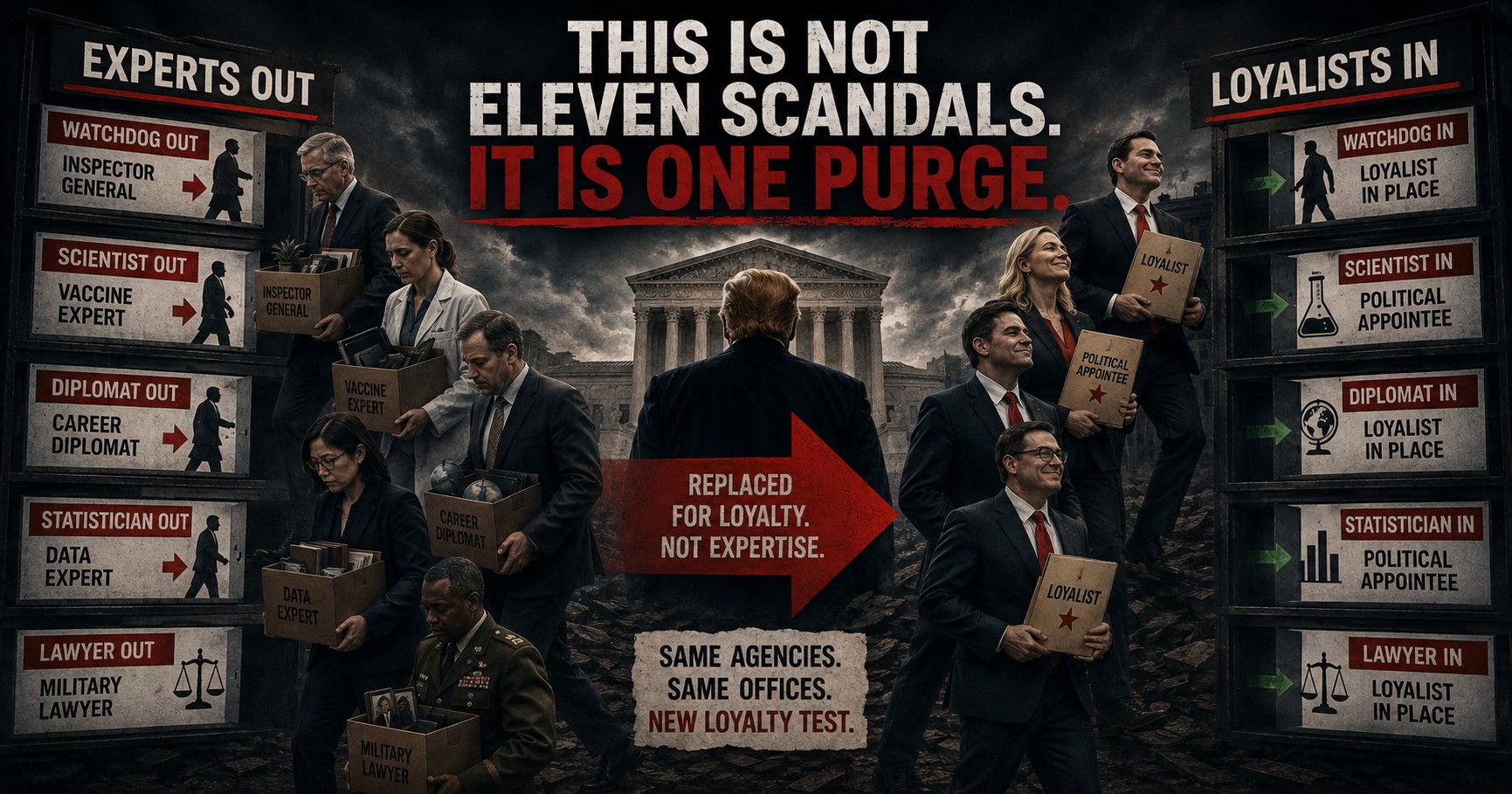
The mechanism is specific enough to be worth stating plainly. An agency has some function, a scientific panel, an inspector general, a career expert corps, a commission designed to outlast any one administration, that is supposed to operate independently of the president’s day-to-day preferences. Someone whose loyalty runs to the president personally, not to the institution, is installed over it or put in charge of removing whoever was there before. When someone inside objects on the record, they are fired, sidelined, or overruled, and the objection gets conceded only at the smallest margin politically necessary, if at all. This publication has already told that story three separate times, at three unrelated agencies. Counting how many more times it has actually happened is the point of this piece.
Day Four
Four days after the inauguration, on January 24, 2025, Trump fired inspectors general at 17 different agencies in a single night, without the 30 days’ notice to Congress the law requires. A federal judge (Ana C. Reyes) ruled in September 2025 that the firings were unlawful, but declined to reinstate the fired IGs, since the administration could simply refire them after giving the required notice. Replacements have included people with direct ties to the administration: USDA’s new inspector general, sworn in January 2026, previously served as a senior adviser to the Agriculture Secretary and, in Trump’s first term, as an associate White House counsel. A former inspector general’s assessment of what replaced them: “Now watchdogs are being taken off the playing field and replaced with partisan individuals tied to the administration.” More than a dozen federal agencies still have no independent watchdog at all.
That happened before the administration’s first full week was over. Everything below happened after it.
The Ones Already on the Record
Three agencies get only a brief mention here because this publication has already reported each one in full. At Voice of America and DHS, a political appointee broke a statutory newsroom firewall and a federal department ran what amounted to propaganda in violation of a decades-old appropriations doctrine, and getting caught by a judge changed nothing about what either agency did next. At HHS, Kennedy fired the CDC’s entire vaccine advisory committee in a “clean sweep,” his own hand-picked CDC director was fired weeks later for refusing to pre-approve his conclusions and fire career staff without cause, and a Texas subpoena followed, landing on the one medical body that refused to go along, a dynamic this publication named before Kennedy even had the job. At DOJ, Todd Blanche, Trump’s own former personal criminal defense lawyer, now runs the agency built to prosecute people like his former client, deciding whether to pay Trump a $230 million claim and settling an IRS suit a federal judge called theater.
The Bureau
FBI Director Kash Patel has fired or sidelined senior agents and officials tied to the January 6 investigation and the Mar-a-Lago documents case, including a former Washington field office leader on the Jan. 6 case and Miami agents who worked the documents search. Three of the fired agents have sued Patel and Attorney General Pam Bondi, alleging in a federal complaint that Patel told one of them directly that his own job as director depended on firing the people his superiors named. Their lawsuit has drawn broad support from former officials across administrations. This is the same shape as the DOJ story above, one level down: the agency that is supposed to investigate the president’s own conduct, purged of the people who did.
The Rivals
The same mechanism has also turned outward, toward named political opponents rather than just the internal officials who got in the way. In September 2025, interim U.S. Attorney Erik Siebert was pushed out of the Eastern District of Virginia, reportedly for resisting pressure to prosecute New York Attorney General Letitia James. Trump replaced him with Lindsey Halligan, his own former personal lawyer, who had never prosecuted a case. Three days into the job, Halligan indicted former FBI Director James Comey on perjury and obstruction charges, over a memo from career prosecutors in her own office explaining why they believed no probable cause existed. Two weeks later she indicted Letitia James on mortgage fraud charges. On November 24, 2025, U.S. District Judge Cameron McGowan Currie threw both cases out, ruling Halligan’s appointment itself had been unlawful and that everything flowing from it, both indictments included, was void; Comey’s original charges may not even be refileable, since the statute of limitations had already run. It didn’t end there. DOJ indicted Comey again in April 2026, this time in North Carolina, over a social media post of seashells arranged to spell “86 47.” A third Trump critic, former national security adviser John Bolton, was indicted separately in Maryland in October 2025 over his handling of classified material and pleaded guilty in June 2026, the one case among the three where the underlying conduct, not just the appointment that brought the charge, held up.
The Uniform
The purge reached the military too, and it went further than the top of the chain of command. Trump fired Joint Chiefs Chairman Gen. CQ Brown in February 2025. In the same stretch, Defense Secretary Pete Hegseth fired the Navy’s top officer, the Air Force’s second-highest officer, and the judge advocates general of the Army, Navy, and Air Force, the military’s own internal legal officers who oversee its justice system. Firing the JAGs is the cleanest version of the mechanism in uniform: it is not just replacing the chain of command, it is removing the lawyers whose job is to tell that chain of command when an order is illegal.
The Data, the Science, the Diplomats
Three more agencies got the same treatment through their career-expert corps rather than a single dramatic firing. At the Bureau of Labor Statistics, Commissioner Erika McEntarfer, confirmed 86-0, was fired hours after a weak jobs report she had no role in producing. Her proposed replacement, Heritage Foundation economist E.J. Antoni, had no BLS-relevant statistical background, a deleted social-media history of slurs and personal attacks, and a prior public call to “take a chainsaw to the BLS”; the nomination collapsed under bipartisan pressure and was withdrawn, one of the few times this specific move has failed outright.
At the EPA, the agency dismissed the members of its Clean Air Scientific Advisory Committee and Science Advisory Board as part of a “reset.” The internal trigger, obtained by reporters, was an email from an assistant deputy administrator reading “All good, do what y’all need to do,” followed minutes later by “It is done.”
At the State Department, the loyalty requirement was written down rather than inferred. An executive order directed the Secretary of State to reform Foreign Service recruitment and promotion standards so that officers “fully carry out President Trump’s America First foreign policy agenda,” reversing the merit-based standard that had governed Foreign Service promotion for generations. More than 240 Foreign Service officers received termination notices the same year.
A Different Genre, Same Logic
Two more examples don’t fit the science-and-law-enforcement mold but run on the identical logic. At the Kennedy Center, Trump ousted 15-year chairman David Rubenstein, fired half the board, had the remaining board elect him chairman, and replaced the center’s president with a former administration official with no arts-administration background. At NOAA, the mechanism runs in reverse: rather than installing a loyalist, the administration has proposed cutting the agency’s budget by roughly 40 percent and eliminating the research offices behind hurricane and severe-weather forecasting outright. Different method, same result: independent expertise that might contradict the administration doesn’t get replaced with a loyalist, it just stops existing.
What the Court Just Decided
Which brings the story back to June 29, 2026. Trump v. Slaughter did not create this pattern, everything above happened before the ruling came down, but it did something the pattern hadn’t managed on its own: it made the commission-style version of it durable law, not just an aggressive administration’s practice that the next one might reverse. The Court’s own words leave little room to read it narrowly: “if anything more is left of Humphrey’s, it is overruled.” Trump v. Cook, decided hours later, drew the one exception, and Chief Justice Roberts’s majority opinion grounded it specifically in the Federal Reserve’s “historical independence,” not in a broader principle that would have protected the FTC, the NLRB, or anything else.
Two sitting inspectors general have already been ruled against by a federal judge and left in place anyway. A CDC director’s sworn testimony was met with a public accusation of lying from her own former boss. A cabinet-level attorney general who ordered a mass, unlawful firing campaign has not been reversed by Congress. What’s left of the accountability structure Congress built, an inspector general at every major agency, scientific advisory panels insulated from political pressure, a Foreign Service that promotes on merit, independent commissions removal-protected by statute, is not gone everywhere. It has been narrowed everywhere, agency by agency, using the same basic move, in less than eighteen months.
The move itself is not new, only the paperwork is. Removing every independent power center inside your own government and replacing it with people who answer to you personally, not the institution, is how ambitious leaders have consolidated power for the better part of a century. Hitler spent three days in 1934 eliminating the SA leadership and other internal rivals, an episode remembered as the Night of the Long Knives. Stalin spent the following decade hollowing out the Communist Party, the Red Army’s officer corps, and the security services of anyone whose loyalty was in doubt. Both ended in firing squads and show trials. What has happened in Washington runs through actual courts instead, with real defense lawyers and, in Comey and James’s case, a real dismissal once a judge found the prosecutor’s own appointment was unlawful. That distinction matters and should not be flattened. But the direction underneath it, replace the people whose job was independence, and when firing them stops being enough, indict the people who criticize you, is the same one Hitler and Stalin ran through party purges and firing squads. Washington is running it through personnel files, indictments, and a friendly Supreme Court ruling instead.
None of this required a coup, a suspended constitution, or a declared emergency. It required firing the people whose job was to say no, replacing them with people who wouldn’t, and discovering, case after case, that the country’s institutions had few reliable ways to stop it once it started. The Supreme Court just confirmed that for most of them, it can’t.