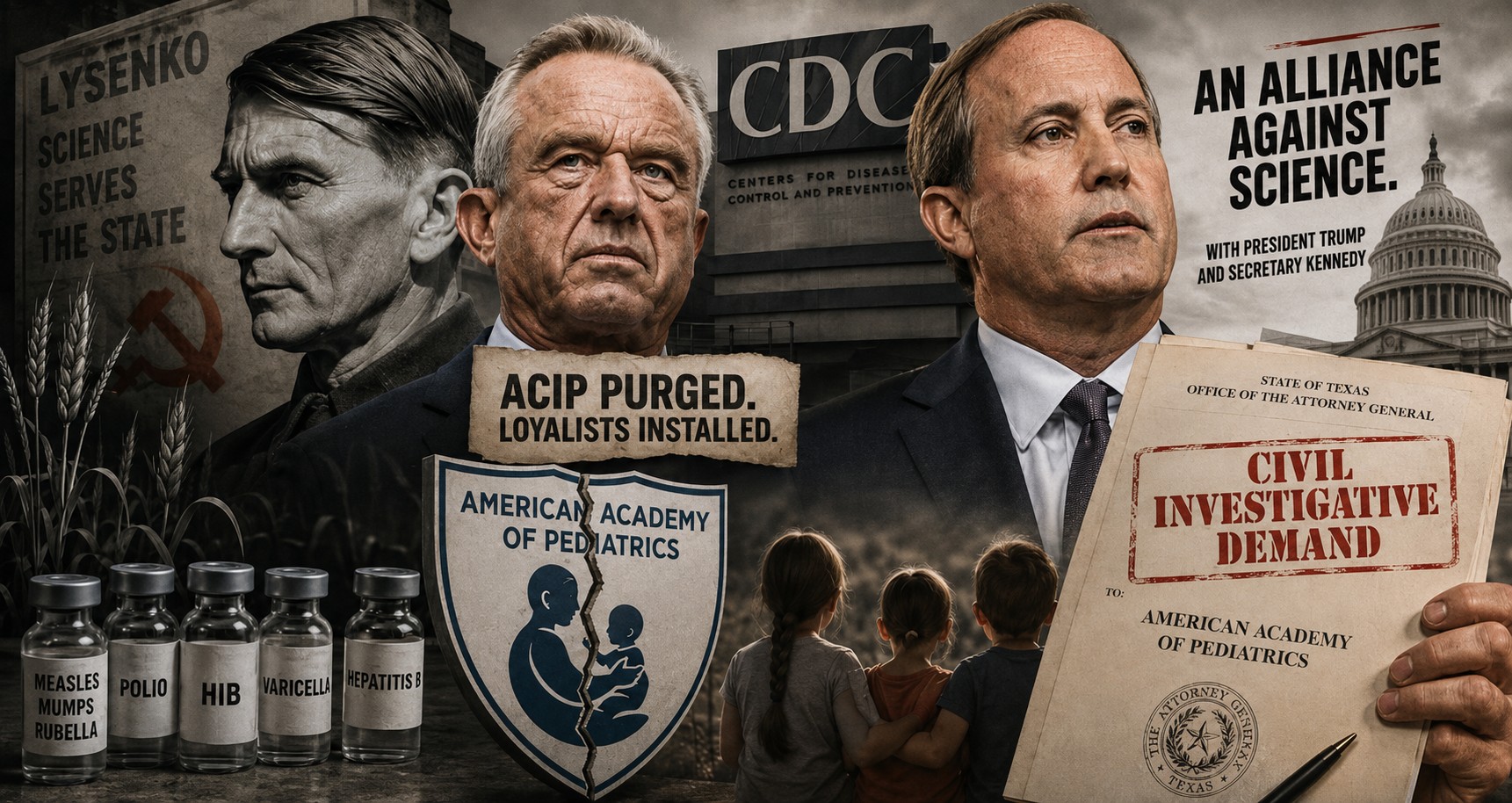
Texas Attorney General Ken Paxton announced on August 5 that his office is investigating the American Academy of Pediatrics, the country’s largest professional association of pediatricians, for “deceptively promoting childhood vaccines for financial gain.” He has issued a Civil Investigative Demand, a subpoena with the threat of enforcement behind it, ordering AAP to explain the basis for its vaccine recommendations.
“Parents deserve vaccine recommendations that are driven by science and the best interests of their children, not by financial gains or bribes from Big Pharma,” Paxton said in the release. “My office will fight to protect kids’ health and uphold transparency in the medical industry alongside President Trump and Secretary Kennedy.”
Read that sentence again. The Texas Attorney General is not describing an independent inquiry. He is describing an alliance, stated plainly, with the President and with HHS Secretary Robert F. Kennedy Jr. And the group he is subpoenaing is the one professional body that publicly refused to go along with what Kennedy did to childhood vaccine policy.
This publication named this dynamic in December 2024, before Kennedy was even confirmed, calling him “America’s Lysenko” for the same reason Trofim Lysenko earned the comparison in the Soviet Union: elevating ideology over evidence, backed by state power, at the expense of the people that power was supposed to protect. What was a prediction then is a documented sequence now, and the AAP subpoena is its newest entry.
The sequence, in order: in June 2025, Kennedy fired all 17 members of the CDC’s Advisory Committee on Immunization Practices and named eight replacements within two days, several with records of opposing childhood immunization or testifying against vaccine manufacturers in lawsuits. His own justification, written in a Wall Street Journal op-ed: “a clean sweep is needed to re-establish public confidence in vaccine science.” Sen. Bill Cassidy, a Republican and a physician, publicly warned that several of the new appointees lacked experience with technologies like mRNA vaccines and “may even have a preconceived bias against them.”
AAP did not fall in line. It sued HHS in July 2025, arguing Kennedy’s changes to the vaccine schedule lacked a scientific basis and that his reconstitution of ACIP was unlawful. Then, on August 19, 2025, for the first time in its history, it broke from the CDC entirely and published its own immunization schedule, continuing to recommend vaccination against all 18 diseases the CDC schedule had covered before Kennedy’s panel cut that list to 11, and urging insurers to cover every one of them.
AAP was not the only one who refused, and the next refusal came from inside Kennedy’s own building. Susan Monarez, his handpicked CDC director, lasted less than a month in the job before she was fired on August 27, 2025. She later told Congress under oath that Kennedy had directed her to commit in advance to approving whatever his handpicked ACIP recommended, regardless of the evidence, and to fire career vaccine-policy officials without cause. She refused both. Kennedy’s own account to the Senate Finance Committee was that he asked her directly whether she was “a trustworthy person,” and that she said no; Monarez’s attorney called that characterization false. Multiple senior CDC officials resigned in protest, and staff walked out. A state attorney general alleging AAP’s science was bought is one thing. The health secretary’s own chosen CDC director testifying under oath that he wanted her signature on his conclusions before she’d seen the evidence is another.
The lawsuit worked, for now. On March 16, 2026, U.S. District Judge Brian Murphy ruled that both the schedule cut and Kennedy’s ACIP appointments were made unlawfully, staying the reduced schedule and every vote the reconstituted panel had taken. The administration appealed, and as of this writing the stay is still in effect and the appeal is still pending at the First Circuit. The practical result: two different childhood vaccine schedules are both technically in circulation this back-to-school season, the CDC’s paused revision and AAP’s own, leaving parents and providers to sort out which one applies.
That is the entire factual basis Paxton’s release offers for a financial-motive theory: AAP’s top donors include pharmaceutical companies that stood to lose money if the CDC dropped vaccines from its schedule, and AAP happened to break with the CDC at the exact moment that was happening. The release treats that timing as damning. It never engages with the far more obvious explanation sitting in its own preceding paragraphs: AAP broke with the CDC at the exact moment the CDC’s own advisory panel was gutted and replaced with Kennedy loyalists. The release describes that purge in detail and then declines to consider it as an alternative to “bribes from Big Pharma.” A subpoena is not required to notice which explanation the evidence actually favors.
This is not the first target in Paxton’s broader vaccine-industry investigation this year. In January 2026, his office issued more than 20 similar demands to insurers, providers, and manufacturers, including Pfizer and UnitedHealthcare by name, over undisclosed financial incentives tied to childhood vaccines. AAP’s own CID came seven months later, which the release frames as growing directly out of that sweep. It’s different from those original targets in one respect worth noting: it’s the only one that publicly defied the administration first.
If financial ties to the vaccine industry are the standard, Paxton’s own network does not clear it. He is the former chair of the Republican Attorneys General Association, which took $150,930 from Pfizer in the 2022 cycle alongside donations from Centene, Aetna, and Anthem, and which in turn gave $250,000 directly to Paxton’s own campaign that same cycle. Follow-the-money logic tends to work in whichever direction the investigator points it.
Kennedy’s own credibility for setting the science AAP is accused of contradicting is worth a look, too. He has no medical or scientific degree; his training is in law and environmental policy. As recently as an August 2, 2026 CNN interview, FactCheck.org documented him making false or misleading claims about COVID-19 vaccine protection in children, autism research, and the origins of Lyme disease and RSV, three days before his office’s investigative target became the group whose president that same interview was, in effect, defending.
The purge pattern is not confined to ACIP. In January 2026, HHS replaced the entire membership of the Interagency Autism Coordinating Committee, the federal panel that helps set the government’s autism research priorities, appointing 21 entirely new members, none of whom had previously served on it. At least eight had prior ties to anti-vaccine advocacy, including John Gilmore of the Autism Action Network and Toby Rogers, a Brownstone Institute fellow who has testified to Congress that chronic disease is “primarily caused by toxicants, mostly from vaccines.”
And the pressure is not stopping at HHS. Bloomberg reported on August 6, one day after Paxton’s CID against AAP, that the White House is actively weighing an executive order on vaccines and autism, possibly within the week, targeting the childhood immunization schedule and directing new research into a vaccine-autism link the science has already closed the book on. CNN reported the push is personal to Trump, who has pressed Kennedy directly and repeatedly suggested, without evidence, that vaccines cause autism, a claim he has tied publicly to his own account of spacing out his son Barron’s childhood vaccinations. CNN also reported that many of Trump’s own aides and political advisers are warning him against it, worried that elevating the issue could cost Republicans in November’s midterms. He appears willing to spend that capital anyway.
None of this makes Lysenko and Kennedy the same man, or 2026 America the Soviet Union. Nobody at ACIP or the IACC was arrested. AAP is fighting back in open court, with lawyers and a functioning judiciary, and for now it is winning: the schedule cut and the reconstituted ACIP are both still under a federal injunction. Those are tools Soviet geneticists never had. What repeats is the mechanism, not the body count: install loyalists without the relevant expertise, remove the experts who might object, and when an institution refuses to go along and fights back through the system built for exactly that, turn the power of the state on it anyway rather than on the evidence, and escalate at the top when a subpoena isn’t enough. We named that mechanism in this administration before it had done any of this. It now has a subpoena number, two purged federal panels, and a president reportedly willing to spend his own party’s midterm chances on an executive order to keep going.