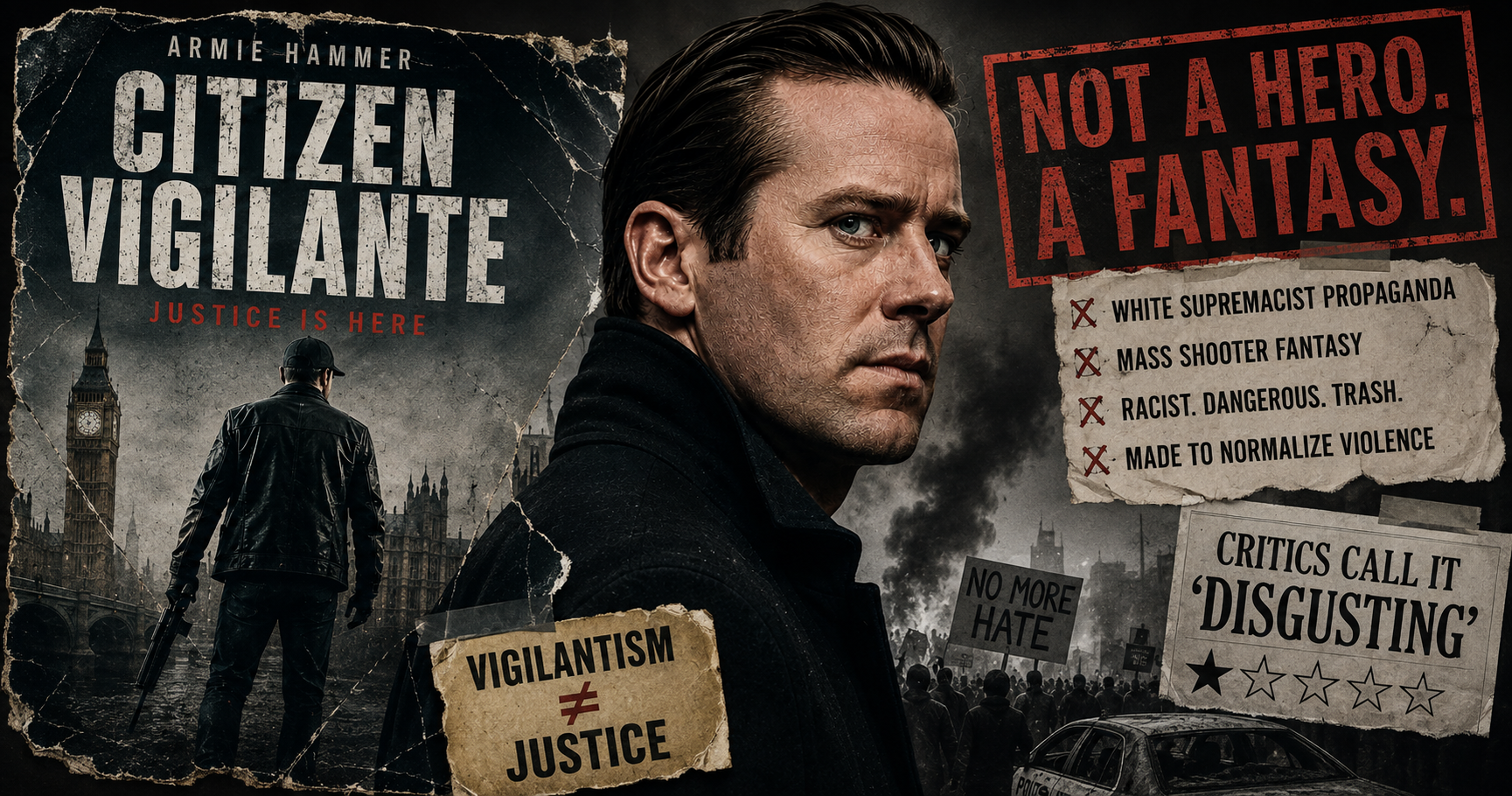
Citizen Vigilante is what happens when a white-nationalist social-media rant is given a camera, a disgraced leading man and the delusion that it has become cinema.
Written and directed by Uwe Boll and starring Armie Hammer, the film follows a wealthy American expatriate who decides that Europe has been conquered by Muslim migrants, betrayed by liberal judges and abandoned by the police. He responds by collecting weapons, recording manifestos and murdering the people he blames.
The movie wants to be Death Wish. It wants to be Dirty Harry. It may even imagine itself as a politically incorrect successor to Taxi Driver.
It is none of those things.
Those films, whatever their politics, were made by people who understood character, motivation, suspense and moral conflict. Citizen Vigilante removes all of that and leaves behind only the fantasy of an aggrieved white man appointing himself judge, jury and executioner.
This is not a vigilante thriller with ugly politics.
It is an ideological mass-shooting fantasy wrapped in action-movie packaging.
Even Reactionary Movies Need a Story
Vigilante films are often politically reactionary. That is built into the genre.
The police are ineffective. The courts are permissive. Criminals operate without consequences. A wounded man, usually presented as an embodiment of traditional masculinity, steps outside the law and restores order through violence.
The politics are rarely subtle, but the better examples understand that the violence must be connected to an emotional wound.
John Wick does not begin killing because he has developed an abstract theory of social decline. The murder of his dog severs his final connection to his dead wife. Paul Kersey in Death Wish loses his family to a brutal attack. The protagonists of Man on Fire, Taken and The Equalizer form relationships with people who are then threatened, abducted or harmed.
These films establish an emotional connection before unleashing the violence. That connection does not necessarily make the revenge moral, but it makes it dramatically comprehensible. The audience understands what has been lost and why the protagonist has snapped.
Sanders, Hammer’s character in Citizen Vigilante, has no comparable wound.
No one he loves is murdered. No daughter is kidnapped. No friend is assaulted. He does not appear to have any meaningful connection to the victims whose cases supposedly inspire him. At one point he simply flies to Arizona and fires a gun for the first time in his life, an initiation into violence with no grief or loss behind it at all.
He simply hates migrants.
Sanders believes that African and Muslim immigrants are destroying Europe, that judges are deliberately protecting them and that police officers who enforce the law have become servants of a corrupt liberal regime. The movie then constructs precisely the fictional world required to confirm every one of his paranoid assumptions.
That does not make him a revenge hero.
It makes him an ideologically motivated murderer.
A Mass Shooter With a Publicist
Jamelle Bouie identified the movie’s central dramatic failure in his video review: Sanders behaves less like the protagonist of a revenge thriller than the perpetrator of a politically motivated mass shooting.
That distinction is devastating because it is visible in the structure of the film itself.
Sanders records manifestos. He broadcasts his grievances online. He imagines himself as the only person willing to acknowledge an existential racial and cultural threat. He gains a social-media following that celebrates each new act of violence. The movie periodically shows people around the world applauding him, assuring both Sanders and the audience that millions secretly agree with his campaign.
This is not the psychology of John Wick.
It is the psychology of the lone extremist who has convinced himself that society is asleep, history has selected him for a special purpose and murder is a form of public communication.
“Far from being the kind of character that you see in these other movies,” Bouie says, Sanders “is more like a school shooter type, more like a mass shooter type.” He goes further: “This movie is kind of a valorization of the mass shooter.” In his review, he says the film “feels like an apology for the Dylan Roofs and the Timothy McVeys and the Christ Church shooter and the Tree of Life shooter,” naming the Charleston church shooter, the Oklahoma City bomber, the Christchurch mosque shooter and the Pittsburgh synagogue shooter in the same breath.
The point is not that the fictional Sanders is identical to any one of those real killers. The point, as Bouie lays it out, is that his motivation runs on the same fuel: the belief that society is being deliberately destroyed by immigrants and their domestic collaborators, that normal institutions cannot be trusted, and that private violence is a form of political salvation.
The movie does not meaningfully challenge this worldview. It manufactures a universe in which Sanders is repeatedly proven correct.
That is not moral complexity.
It is propaganda with plausible deniability.
The Climactic Massacre Reveals the Truth
The comparison to political terrorism becomes impossible to avoid during the film’s final massacre.
Sanders confronts a young Muslim immigrant accused of sexual assault. But he does not limit his vengeance to the accused man. He gathers the man’s relatives and friends and murders them too.
They are not attacking him. They pose no immediate threat. They are killed because they are associated with the target and belong to the community Sanders has designated as the enemy.
That is not justice, however primitive.
It is collective punishment.
Guilt has become racial, religious and hereditary. Association itself is punishable by death. The accused man’s relatives become legitimate targets because the movie has already reduced an entire population to an undifferentiated invading mass.
The film presents the scene as a triumphant conclusion.
What it actually depicts is the governing logic of ethnic terrorism.
There is no emotional release because the film never established an emotional injury. There is no rescue. There is no meaningful restoration of order. There is only a man executing unarmed people in service of an ideology.
Sanders is not John Wick with politics.
He is a mass shooter with a publicist.
The Movie Is Also Terrible
None of this should obscure the fact that Citizen Vigilante is, on the most basic technical level, dreadful, and critics overwhelmingly agree. The film holds roughly an 8 percent critics’ score on Rotten Tomatoes, against an audience score above 90 percent, one of the widest critic-audience gaps of the year.
Variety’s Todd Gilchrist called it “a violent, incoherent, morally bankrupt slice of exploitation.” The Guardian’s one-star review put it more simply, noting that Citizen Vigilante wants to be Death Wish, Dirty Harry or Taxi Driver but lacks the “passion, style, wit, purpose, vision and competent production values” of any of them.
The acting is wooden. The editing is disjointed. The sound and color grading have the unfinished quality of a low-budget production that escaped before anyone could complete it. The movie runs roughly 90 minutes but somehow acquires the psychological duration of a hostage situation.
Even its violence is mostly dull.
That is a remarkable failure for a film whose entire reason for existing is to provide violent catharsis. The action lacks momentum, the protagonist lacks charisma and the screenplay lacks anything resembling human behavior. Sanders moves through the movie less like a character than a malfunctioning delivery system for Boll’s political grievances.
Bouie, who says in his review that he genuinely enjoys vigilante and revenge thrillers as a genre, going back to Walking Tall and running through Death Wish, Dirty Harry and Taken, made a point of separating the film’s failure from its politics: “It’s not bad because of its politics. Or rather, it is, but that’s like not the reason why it’s bad.” He did not object to it because the genre is inherently right-wing. He objected because the film is boring, shapeless, technically amateurish and emotionally empty.
That distinction matters.
The film’s defenders would prefer to believe that critics hate it because it is too bold, too honest or too politically incorrect. This is the standard refuge of the talentless provocateur. When the work fails, declare that the audience was frightened by its truth.
But Citizen Vigilante is not being rejected because critics cannot tolerate a right-wing vigilante movie. Film history is filled with popular and critically respected movies whose politics range from conservative to openly reactionary.
It is being rejected because it is tedious, incoherent and inept.
Its politics are repellent.
Its filmmaking is simply incompetent.
Elon Musk Finds His Masterpiece
Under ordinary circumstances, a low-budget Uwe Boll movie starring an actor attempting a comeback might have disappeared quietly into the lower reaches of video-on-demand.
Then Elon Musk found it.
Musk posted the entire movie to his X account for a free 48-hour release to his hundreds of millions of followers. Its visibility surged, and the film became an online right-wing cultural event. When it climbed to number two on Apple TV’s charts, Musk predicted a sequel would be even better.
This was not a case of the world’s richest man discovering an overlooked cinematic achievement.
Musk recognized his own politics on the screen.
The film portrays immigration as an invasion, democratic institutions as complicit, liberal judges as traitors and private violence as the only remaining form of meaningful citizenship. These are not incidental themes. They are the ideological engine of the movie.
Musk has repeatedly used his platform to amplify racialized claims about immigration, demographic replacement and the supposed destruction of Western civilization. Citizen Vigilante turns that worldview into an action fantasy. It gives the paranoid social-media feed a hero, a gun and permission to kill.
For Musk, artistic quality was beside the point.
The movie was valuable because it validated the narrative.
None of this is a foreign import into American politics. It is Trump’s own language, restaged with a bigger budget. His first-day executive order was titled “Protecting the American People Against Invasion,” and his inaugural address promised to “send troops to the southern border to repel the disastrous invasion of our country.” Days before this piece went to press, he called a wave of migrants crossing into the Spanish enclave of Ceuta “an invasion of a country by hundreds of thousands of people,” warning that the same thing would happen in the United States again, “except worse, much bigger, much easier to get into,” if Republicans lost power.
Musk reacted to the same story by posting a clip from the zombie film World War Z, a horde scaling a fortress wall, captioned “Wow, the situation in Spain looks crazy!” He later called the post a joke, then followed it with real footage from the U.S. border, captioned “This was the United States under Biden.” Only the metaphor changed. It is the exact move Citizen Vigilante makes for ninety minutes: take a real migration story, drain it of any individual human being, and restage it as a monster movie. Sanders is not an aberration of this worldview. He is what it looks like when someone finally acts on it.
The Propaganda Network Goes to Work
Musk was not acting alone.
The film was quickly embraced by a familiar network of right-wing media personalities and influencers.
Patrick Bet-David praised it for channeling public rage at governments that supposedly refuse to protect their citizens. Libs of TikTok celebrated its commercial success, including its run to number one on Amazon Prime. Jack Posobiec promoted the film through a censorship narrative, contrasting its treatment in Germany with a Best Picture-nominated film about Black southern life: “Sinners is a movie about killing white people and has the all-time record for Oscar nominations of any film in history. Yet Citizen Vigilante was banned.”
Boll also appeared on a podcast hosted by Mark Collett, leader of the British white-nationalist organization Patriotic Alternative. There, Boll defended the film’s anti-migrant message and presented it as an expression of what ordinary people supposedly believe but are too frightened to say.
This was not an audience discovering a hidden gem.
It was a political movement discovering a piece of propaganda that confirmed everything it already believed.
The movie’s artistic failure did not matter because many of its admirers were not evaluating it as art. They were treating praise for the film as an ideological declaration. Giving it a positive rating became another way to announce opposition to immigration, liberalism and the supposed tyranny of mainstream culture.
The audience was not reviewing the movie.
It was voting for the massacre.
The Convenient Myth of the German Ban
The film’s mythology also depends heavily on the claim that Germany “banned” it.
The reality is more complicated. Germany’s FSK ratings board twice declined to give the film a classification, a decision that blocked its ordinary theatrical release and kept it out of standard promotion, though it did not criminalize private possession or viewing. Boll challenged the ruling, and by July, the board reversed itself and granted the film an adults-only theatrical rating, clearing it for German cinemas even as its path to streaming and home video in the country remains separately unresolved.
That reversal has not made it into the film’s marketing. “Classification denied, twice, then partially reversed on appeal” does not carry the same charge as “banned by the establishment,” so the more complicated and now-outdated story is the one that stuck.
The rhetorical trick mirrors the movie itself.
A complicated institutional decision becomes proof of totalitarian censorship. A flawed justice system becomes proof that judges are traitors. Individual crimes become proof of an immigrant invasion. Political disagreement becomes complicity.
Once every institution has been declared corrupt, violence can be presented as the only honest response.
That is the real political project of Citizen Vigilante.
It does not merely ask viewers to hate migrants. It asks them to conclude that courts, police, governments, journalists and cultural institutions are all collaborating in the destruction of society.
At that point, the vigilante is no longer breaking the law.
He is replacing it.
Propaganda Without Competence
There is such a thing as effective propaganda.
Effective propaganda understands emotion. It gives the audience someone to love, something to fear and a story that transforms prejudice into apparent moral necessity.
Citizen Vigilante barely manages even that.
Its characters are cardboard. Its enemies are caricatures. Its hero has no interior life beyond grievance. Its political claims are so crudely arranged that the movie feels less like a narrative than a series of execution scenes connected by angry social-media posts.
Yet its incompetence does not make it harmless.
A badly made movie can still normalize an idea. Repetition does not require artistry. The message reaches the audience even when the screenplay fails: migrants are invaders, judges are collaborators, police officers who enforce the law are enemies, and the man willing to kill them all is the true citizen.
That message becomes especially dangerous when it is promoted by one of the wealthiest and most influential men in the world to an audience already saturated with conspiracy theories about immigration and demographic replacement.
Citizen Vigilante is not a warning about what happens when the justice system fails.
It is a fantasy about what happens after people have been persuaded that the justice system, democracy and pluralistic society are themselves the enemy.
The movie wants viewers to cheer a man who publishes manifestos, appoints himself judge and executioner, murders police officers and exterminates the relatives of an accused criminal.
That is not vigilantism.
It is terrorism with a fan club.
The most revealing thing about Citizen Vigilante is not that Uwe Boll made it.
It is how many powerful people were eager to applaud.