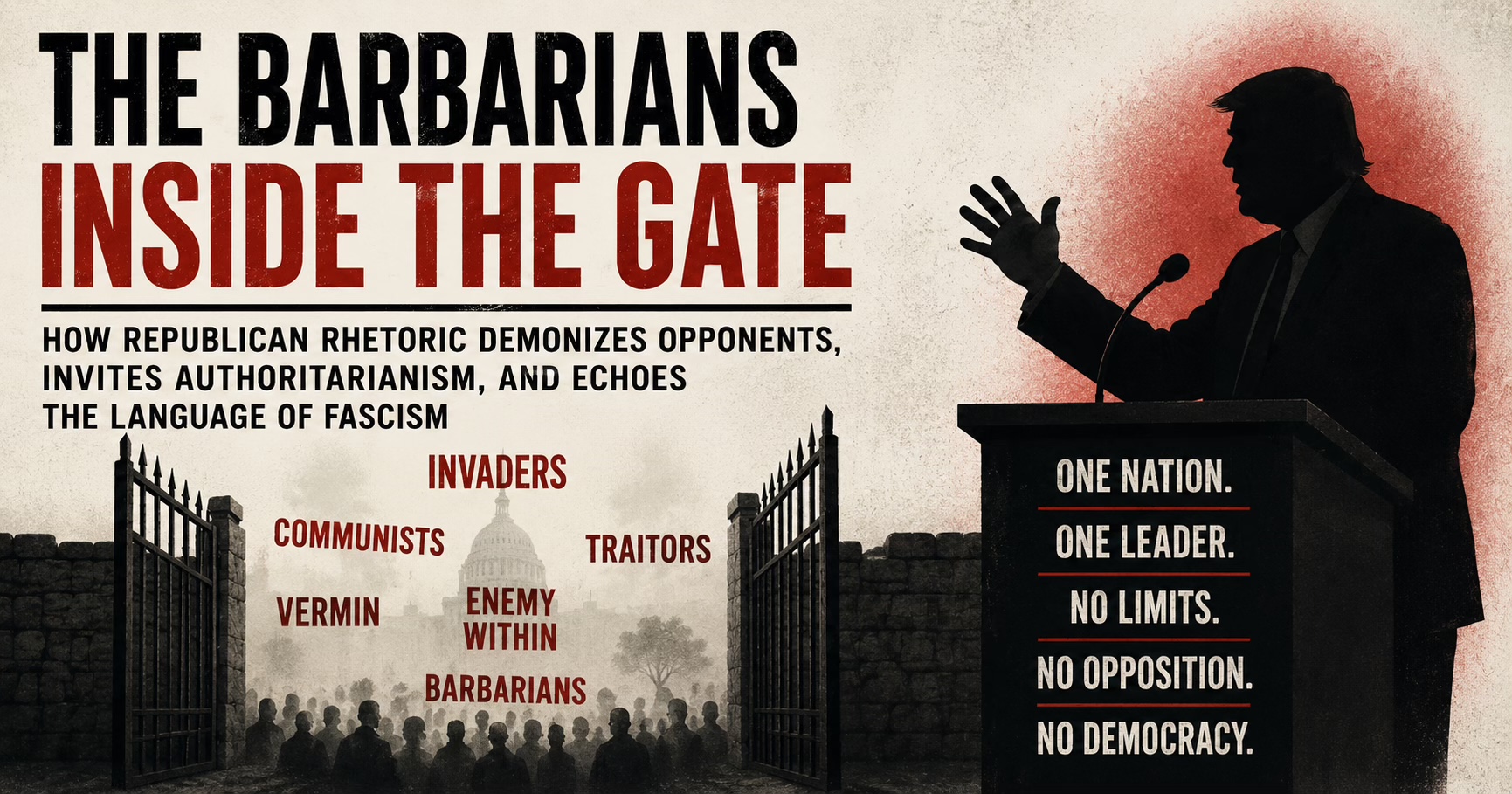
On July 14, Speaker of the House Mike Johnson warned that communism was no longer a threat on some distant shore. It had entered American politics itself.
“The barbarians are inside the gate,” he declared.
Johnson did not invent the phrase. Thomas Sowell published Barbarians Inside the Gates and Other Controversial Essays in 1999, a collection addressing immigration, multiculturalism, the media, education and other alleged sources of American cultural decline. Johnson’s use of the phrase appears to draw deliberately from that conservative intellectual tradition.
But the origin of the metaphor does not make Johnson’s use of it harmless. It makes it more revealing.
Barbarians are not fellow citizens with mistaken ideas. They are enemies of civilization. They do not belong inside the gate. Their presence means that the defenses have failed and that the society they have penetrated faces an existential threat.
Johnson was not talking about an invading army. He was talking about Americans participating in democratic politics.
His remark belongs to a much larger pattern in contemporary Republican rhetoric. Political opponents are no longer merely liberal, misguided, incompetent or wrong. They are communists, Marxists, traitors, vermin, barbarians and enemies within. Immigrants are not simply people who entered the country unlawfully. They are invaders. Government officials who enforce laws against the president are not independent public servants. They are members of a hostile “deep state.” Journalists are enemies of the people. Judges who rule against the administration are corrupt. Elections lost by Republicans are rigged.
Taken individually, each phrase can be dismissed as exaggeration. Taken together, they form a coherent political narrative:
America is under attack from outside. It has been betrayed from inside. Its institutions have been captured. Ordinary democratic government is incapable of saving it. Therefore, only a powerful leader unconstrained by those institutions can restore the nation.
That is the classic rhetorical arc of fascism.
From Opponents to Enemies
Democracy assumes that political opponents remain legitimate members of the political community. They may be dishonest, reckless or profoundly mistaken, but they retain the right to organize, vote, hold office and compete for power.
The idea of a “loyal opposition” is essential. Without it, losing an election becomes intolerable because victory by the opposing party is no longer merely a policy setback. It becomes the occupation of the country by an enemy.
Donald Trump has repeatedly described his political opponents as “the enemy from within.” During the 2024 campaign, he said the internal enemy was more dangerous than countries such as China and Russia and suggested that the National Guard, or, if necessary, the military, could be used against it. He has also promised to “root out” communists, Marxists, fascists and “radical left thugs” who live “like vermin” within the country. (The Atlantic)
The word vermin matters.
Vermin are not persuaded, debated or defeated in an election. They are exterminated. The metaphor strips its target of individuality and moral standing. It transforms human beings into an infestation.
Johnson’s “barbarians” is more polished, but it performs much the same work. Vermin exist outside humanity. Barbarians exist outside civilization. The enemy within exists outside the nation. Each metaphor places some Americans beyond the boundaries of legitimate political life.
This does not mean that every person using one of these words intends genocide or dictatorship. Historical comparison is not the same as historical equivalence. It does mean that the language belongs to a recognizable political tradition in which the public is divided between the authentic nation and the enemies allegedly corrupting it.
A common objection is that this is simply partisan mirroring: Democrats also call their opponents fascists, Nazis and threats to democracy, so treating one side’s language as diagnostic while dismissing the other’s as ordinary hyperbole is itself a partisan judgment. But the two are not the same kind of claim. Calling a leader authoritarian is an accusation about conduct. It can be checked against what that leader actually does: does he defy court orders, jail critics, reject an election he lost? The claim can turn out to be wrong. Calling an opponent a barbarian, a piece of vermin or an invader is not an accusation about conduct at all. It is a claim about standing, that the person is not a legitimate participant in the political community regardless of what they do. One kind of rhetoric can be refuted by the facts. The other kind removes the facts from consideration before the argument even starts.
Fascist politics depends upon that division. The nation is imagined as a unified people with a single will. Those who reject the movement cannot merely have different interests or beliefs because, in the fascist conception, the true people are already united. Dissent must therefore come from outsiders, degenerates, infiltrators or traitors.
The opponent is not simply wrong. The opponent does not truly belong.
From Immigrants to Invaders
The rhetoric of invasion has become so routine that its implications are easily overlooked.
Republicans increasingly describe immigration not as a difficult question involving border enforcement, labor markets, asylum law and human rights, but as a military assault on the United States. Immigrants are “invaders.” The border is a battlefield. The government must “repel” them.
This framing is no longer confined to campaign rallies or social media. On January 20, 2025, Trump signed an executive order titled “Protecting the American People Against Invasion.” The order described immigration enforcement as vital to national security and presented unauthorized migration as an attack on American sovereignty. The same title appears in the official Federal Register.
The choice of language changes the category of the people involved.
An immigrant is a civilian whose individual circumstances may be evaluated under law. An asylum seeker may have a claim to be heard. An undocumented worker may have a family, a history and legal rights even while being subject to removal.
An invader is something else. An invader is a hostile combatant. Invaders are not granted hearings. They are repelled, captured and defeated.
The progression is straightforward:
Immigrants become invaders. Migration becomes an invasion. The border becomes a battlefield. Civil enforcement becomes national defense. Deportation becomes the expulsion of an occupying force.
Once those premises are accepted, anyone who favors asylum protections, due process or less punitive enforcement can be portrayed as assisting the invading army.
Democrats are then no longer simply wrong about immigration. They are opening the gates.
From Disagreement to Treason
This is where the external enemy and the internal enemy merge.
If the United States is genuinely being invaded, and Democratic officials knowingly permit or encourage that invasion, then the accusation of betrayal follows almost automatically. The language of policy disagreement gives way to the language of wartime loyalty.
The reasoning goes something like this:
The immigrants are invaders.
The country is under attack.
Democrats deliberately allowed the invaders to enter.
Therefore, Democrats are aiding the enemy.
Those who aid the enemy are traitors.
This is not legally sound. The Constitution deliberately defines treason narrowly as levying war against the United States or adhering to its enemies by giving them aid and comfort. The framers restricted the offense because accusations of treason had historically been used by governments to punish political opposition.
But political rhetoric does not need to satisfy the constitutional definition. Its purpose is to create the emotional conclusion that the opposition has betrayed the country and deserves punishment.
That conclusion is no longer merely implicit. Trump has explicitly called Democratic lawmakers “traitors” and suggested that conduct he characterized as seditious could be punishable by death. In one such incident, he targeted Democratic military veterans and national-security professionals who had reminded service members that they could refuse illegal orders.
This is the danger of the invasion metaphor. Once the nation is imagined to be at war, dissent becomes disloyalty. Restraint becomes weakness. Due process becomes assistance to the enemy. Opposition to the leader becomes opposition to the country itself.
The democratic presumption, that one’s opponents may be loyal citizens acting in good faith, is replaced by a darker presumption: anyone obstructing the movement must be corrupt, subversive or treasonous.
The Institutions Have Been Captured
The siege narrative must also explain why the alleged enemy has not already been defeated.
The answer is that the institutions themselves have been infiltrated.
Courts are corrupt when they rule against Trump. Prosecutors are conducting political witch hunts when they investigate him. Elections are rigged when he loses. The press is an enemy when it reports information damaging to him. Universities are centers of indoctrination. Career officials are part of a deep state. Democratic cities are occupied territory. Federal agencies are weaponized unless they serve the president’s objectives.
The argument is self-sealing.
Evidence against the leader proves the investigators are corrupt. An adverse court ruling proves that the judiciary has been captured. An election defeat proves the election was fraudulent. Critical reporting proves that journalists are enemies.
Every attempt by an independent institution to constrain the leader becomes further evidence that independent institutions must be brought under his control.
This is how constitutional safeguards are transformed in the public imagination from protections against tyranny into obstacles preventing the nation from defending itself.
A legislature that deliberates is weak.
A court that insists upon rights protects invaders and criminals.
A civil servant who follows a statute instead of a presidential command is insubordinate.
A military officer who refuses an illegal order is disloyal.
Under the logic of emergency, institutional independence becomes indistinguishable from sabotage.
The Strongman at the End of the Argument
Once the country has been described as a nation under siege, the conclusion almost writes itself.
The danger is existential. The enemy is both outside and inside. The institutions are compromised. Elections cannot reliably remove the threat because elections themselves may be rigged. Courts cannot be trusted because judges may be corrupt. Congress cannot act quickly enough. Laws written for normal times are inadequate to the emergency.
What remains is the strongman.
He alone understands the scale of the threat. He alone represents the “real” nation. He alone possesses the will to act while weaker leaders hesitate.
Because the emergency is existential, his violations of law become necessary acts of national defense.
Because his opponents are traitors, prosecuting them becomes justice.
Because the government has been infiltrated, purging it becomes reform.
Because the press assists the enemy, suppressing it becomes protection.
Because unfavorable elections may be fraudulent, rejecting their results becomes patriotism.
Historical fascist movements rejected democratic pluralism and argued that only a powerful leader could embody the unified national will. Scholarship on American fascist groups similarly notes their belief that democracy had failed and that only a strongman could create the national unity they sought.
The strongman does not initially ask the public to abandon democracy as an abstract principle. He tells them that democracy has already been stolen from them.
He does not say that he intends to destroy the Constitution. He says that extraordinary power is necessary to save the Constitution from people who secretly hate it.
He does not present repression as tyranny. He presents it as self-defense.
The process depends on the order of operations.
First, create the emergency.
Then identify the internal enemy.
Then discredit every institution capable of restraining the leader.
Finally, present the leader’s freedom from restraint as the only remaining defense of the nation.
Authoritarianism arrives under the promise of rescue.
Is This Fascism?
The word fascism is often used so loosely that it can become meaningless. Not every authoritarian is a fascist. Not every nationalist movement is fascist. Not every act of political repression reproduces Germany in 1933 or Italy in 1922.
But avoiding careless labels does not require ignoring obvious historical patterns.
Fascism has taken different forms in different countries, but several recurring characteristics are relevant here: extreme nationalism, the construction of internal enemies, hostility toward pluralism, the subordination of institutions to a leader, the promise of national rebirth and the portrayal of political violence or repression as necessary self-defense. The United States Holocaust Memorial Museum describes fascism as ultranationalist and authoritarian, rejecting democratic government in favor of rule by a leader claiming to embody the national will.
The question is therefore not whether every detail of historical fascism has already been reproduced.
The question is whether Republican leaders are increasingly teaching their supporters to think in the categories that make fascist government possible.
Is the nation a collection of citizens with different beliefs, or does it belong only to the “real Americans”?
Are Democrats legitimate opponents, or are they communists, barbarians and enemies within?
Are immigrants civilians subject to law, or are they an invading army?
Are independent courts essential safeguards, or are they captured institutions protecting traitors?
Is the president a public official limited by law, or is he the embodiment of the nation whose power must expand to meet an existential threat?
The answers increasingly supplied by Republican rhetoric all point in the same direction.
Inside the Gate
Mike Johnson’s statement matters because it condensed the entire argument into six words.
“The barbarians are inside the gate.”
There is an inside and an outside. There is civilization and barbarism. There are people who belong and people whose presence is itself a threat.
Johnson was speaking about political opposition, but his metaphor leaves little room for democratic coexistence. A society does not compromise with barbarians inside its gate. It drives them out.
That is the destination of this rhetoric: an invasion story that ends, as it always does, with the case for one man’s unrestrained power.
None of this proves that the endpoint is inevitable. It does show that the road is familiar.
The purpose of studying fascism is not to wait until the uniforms, symbols and atrocities of the past have been recreated exactly. By then, historical recognition is useless.
The warning signs appear earlier, in the stories a political movement tells about who belongs, who threatens the nation and why ordinary democratic restraints must be swept aside.
The barbarians inside the gate are not the people Mike Johnson wants Americans to fear.
The only invasion underway is the one persuading Americans that some of their neighbors don’t belong inside the gate.