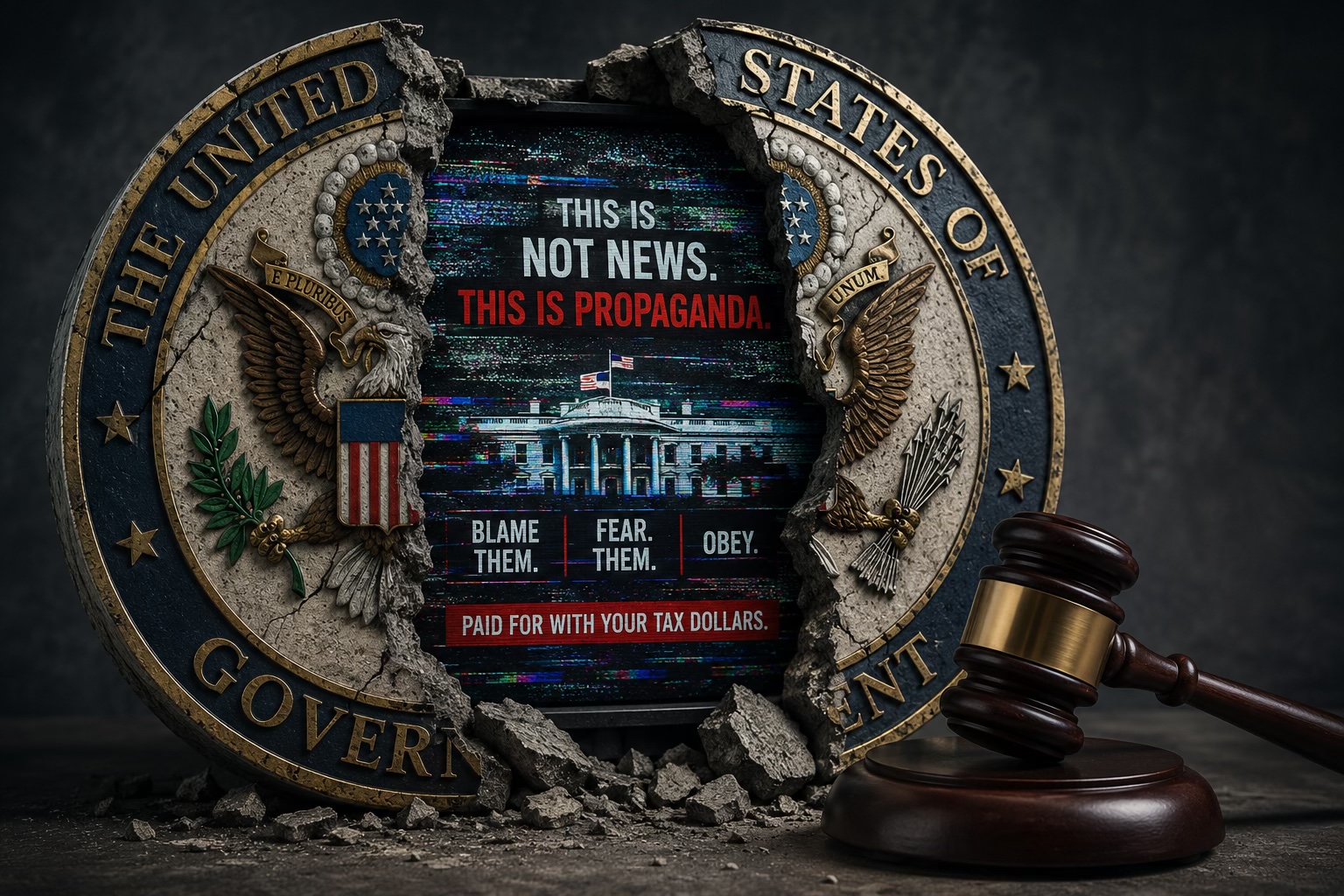
Congress already wrote the laws that were supposed to prevent this. A federal statute requires Voice of America to report the news “accurately, objectively, and comprehensively” and forbids any government official from interfering with that reporting. A decades-old federal appropriations rule bars agencies from spending taxpayer money on “publicity or propaganda.” Both protections exist because lawmakers, at some point, correctly anticipated that a future administration might try to turn government communications into a partisan messaging operation, and decided to stop it in advance.
Right now, agencies across the federal government are violating both rules at once, not as an isolated slip but as an emerging habit. Federal judges have already told at least two of them so, in separate rulings, months apart. None of them have stopped.
Voice of America
VOA’s charter, codified at 22 U.S.C. § 6202, is not a mission statement. It is law, and it comes with a “firewall”: a legal bar on political officials directing what the network’s journalists report. Kari Lake, installed as a “senior adviser” at the U.S. Agency for Global Media because Trump could not lawfully name her VOA’s director outright, spent her first weeks in the job ordering all VOA programming halted and placing more than 1,300 staff on paid administrative leave. In March 2026, Judge Royce Lamberth, a Reagan appointee, ruled she had no lawful authority to do any of it and nullified the firings.
That ruling did not restore an independent newsroom. VOA staff and press-freedom groups have since sued Lake and USAGM directly, alleging she is running propaganda on the network, pointing to her own on-air appearance on VOA’s Persian-language service, where she personally praised Trump in exactly the kind of political messaging the firewall exists to keep out of VOA programming. Meanwhile USAGM signed a memorandum of understanding to carry newsfeed content from One America News, a partisan cable network, across VOA, Radio Martí, and the Office of Cuba Broadcasting. VOA’s own chief national correspondent warned that piping a private partisan outlet’s coverage through a statutorily independent government broadcaster would itself violate the charter. As of April, VOA remains in what reporters are calling “turmoil”, a court win on paper that has not translated into a functioning, independent newsroom in practice.
The Department of Homeland Security
The “publicity or propaganda” restriction on federal spending is not new or novel; the Government Accountability Office has enforced it against agencies for decades, including a finding against the EPA for exactly this kind of violation. It exists to stop agencies from using appropriated money to sell the public on the agency itself, or on a political position, rather than to inform.
DHS’s official accounts have run recruitment content set to a song popular in neo-Nazi spaces, posted less than 48 hours after a fatal ICE shooting in Minneapolis, and a “fashwave” video, a genre associated with far-right propaganda. DHS and the White House have also used pop songs by Olivia Rodrigo and Sabrina Carpenter in enforcement and self-deportation promotional videos without permission; Carpenter called the result “evil and disgusting,” and Rodrigo told the agency directly not to use her music “to promote your racist, hateful propaganda.” When DHS runs its own “fact check” releases rebutting news coverage, it has been caught doing the same selective framing it accuses reporters of, dropping the word “serious” from a stat about ICE arrestees’ criminal convictions that the outlet it was rebutting had actually used.
A Government-Wide Shutdown Script
When federal funding lapsed on October 1, 2025, the pattern stopped looking like scattered agency messaging and started looking like a coordinated script. HUD posted a banner the day before the shutdown even began: “The Radical Left in Congress shut down the government. HUD will use available resources to help Americans in need.” Within hours, other agencies followed with strikingly similar language. USDA’s homepage read: “Due to the Radical Left Democrat shutdown, this government website will not be updated during the funding lapse. President Trump has made it clear he wants to keep the government open.” A pop-up on the Justice Department’s website stated “Democrats have shut down the government.” The State Department blamed “the Democrat-led shutdown,” and the White House ran a “shutdown clock” over the words “Democrats Have Shut Down the Government,” leaving it ticking for days after the shutdown had actually ended. Treasury and the Forest Service posted comparable banners of their own.
The Education Department went further than a banner. It rewrote furloughed employees’ automatic out-of-office email replies to blame “Democrat senators,” without telling the employees whose names were attached to those messages. U.S. District Judge Christopher Cooper ruled the practice unconstitutional: “When government employees enter public service, they do not sign away their First Amendment rights, and they certainly do not sign up to be a billboard for any given administration’s partisan views.” He ordered the department to restore the messages employees had actually written, and it complied shortly before the shutdown ended.
Sen. Mark Warner and colleagues formally demanded the removal of what they called, without hedging, “political propaganda” from federal websites and communication channels. Public Citizen and other watchdog groups filed Hatch Act complaints against HUD, HHS, and the Forest Service over the messaging. Those complaints went nowhere while it mattered: the Office of Special Counsel’s Hatch Act enforcement unit, and the Merit Systems Protection Board that would hear any resulting case, were themselves furloughed for the length of the shutdown. The one mechanism built to police this exact violation was switched off by the very event it should have been policing.
The messaging also moved off screens people choose to look at and onto ones they cannot avoid. During the October 2025 government shutdown, then-Secretary Kristi Noem recorded a video that ran on TSA-controlled monitors at airport security checkpoints, telling travelers that “Democrats in Congress refuse to fund the federal government” and that TSA staff were working without pay as a result. Major airports, including LaGuardia, JFK, Newark, O’Hare, and San Francisco, refused to air it, several citing existing policies against political messaging at their facilities, and Democratic senators called for a Hatch Act investigation into whether DHS had used a federal agency to run a partisan attack ad.
That tactic outlived the shutdown, and eventually outlived the secretary who starred in it. Federal funding lapsed again in February 2026, and DHS ran the identical framing a second time: a March 17, 2026 department press release blamed “Democrats’ Reckless DHS Shutdown” for TSA officers going unpaid “for the third time in nearly six months.” This is not free-floating bad judgment. It is expensive: senators including Ruben Gallego called for an investigation into a $220 million DHS advertising contract awarded to firms with close ties to Noem and other senior officials, taxpayer money spent, on the senators’ account, to benefit the people directing where it goes. That scandal was serious enough to help end her tenure: by March 2026, Trump had fired Noem, and the Senate confirmed Markwayne Mullin as her replacement. Removing the secretary did not touch the practice. Mullin’s DHS ran the same “Democrats did this” messaging through the very next funding fight anyway.
Congress itself has already concluded the underlying pattern crosses a legal line: Rep. Shri Thanedar’s proposed DHS CANDOR Act states plainly that DHS’s official accounts have been used “to disseminate lies, inflammatory rhetoric, and partisan political content,” and would require the department’s inspector general to audit its own communications for compliance with federal law.
The pattern, not the exception
Look at what these cases actually have in common. None of them is an agency merely communicating in a way critics found distasteful or one-sided. In each case, Congress had already identified this exact failure mode in advance, whether through VOA’s charter, the appropriations “propaganda” restriction, or the Hatch Act, and passed a law meant to prevent it. In each case, that law has now been invoked against the current administration: by federal judges twice over, Lamberth on VOA and Cooper on the Education Department’s emails, and separately by a Senate investigation request, a House bill, and watchdog complaints. And in each case, getting caught changed nothing about what the agency actually did next. VOA’s OAN deal is still moving. Lake still runs USAGM. DHS did remove the one official most directly implicated, but that is the exception that proves the point: firing Kristi Noem over the ad-contract scandal did not stop the airport-video, blame-Democrats playbook she started. Her successor ran it again during the very next shutdown. And the one enforcement mechanism built specifically for the shutdown-banner violations, the Hatch Act complaint process, could not act on a single one of them while the shutdown that prompted them was still happening, because the shutdown had furloughed the office meant to enforce it.
This publication has already documented another version of the same mechanism: a president using the machinery and authority of the intelligence community itself, the word “declassified,” to make a claim the underlying documents do not support. A broadcaster, a homeland security department, half a dozen other agencies during a single shutdown, and an intelligence community, each governed by its own statute or doctrine, each recruited for the same underlying move: take an institution the law built to be independent of the president’s political interests, specifically because it handles something the public needs to trust, and run it as an extension of his campaign instead.
The distinction between “propaganda” and “government communications” is not a matter of taste. It is a matter that Congress, in each of these cases, already settled by statute, long before any of this happened. The test now is not whether the law says this is illegal. It already does, and a court, a legislator, and a decades-old federal accountability office have each said so out loud. The test is whether being told that by a judge, or by Congress, or by the GAO’s own doctrine, actually stops it. So far, in every case above, it has not.