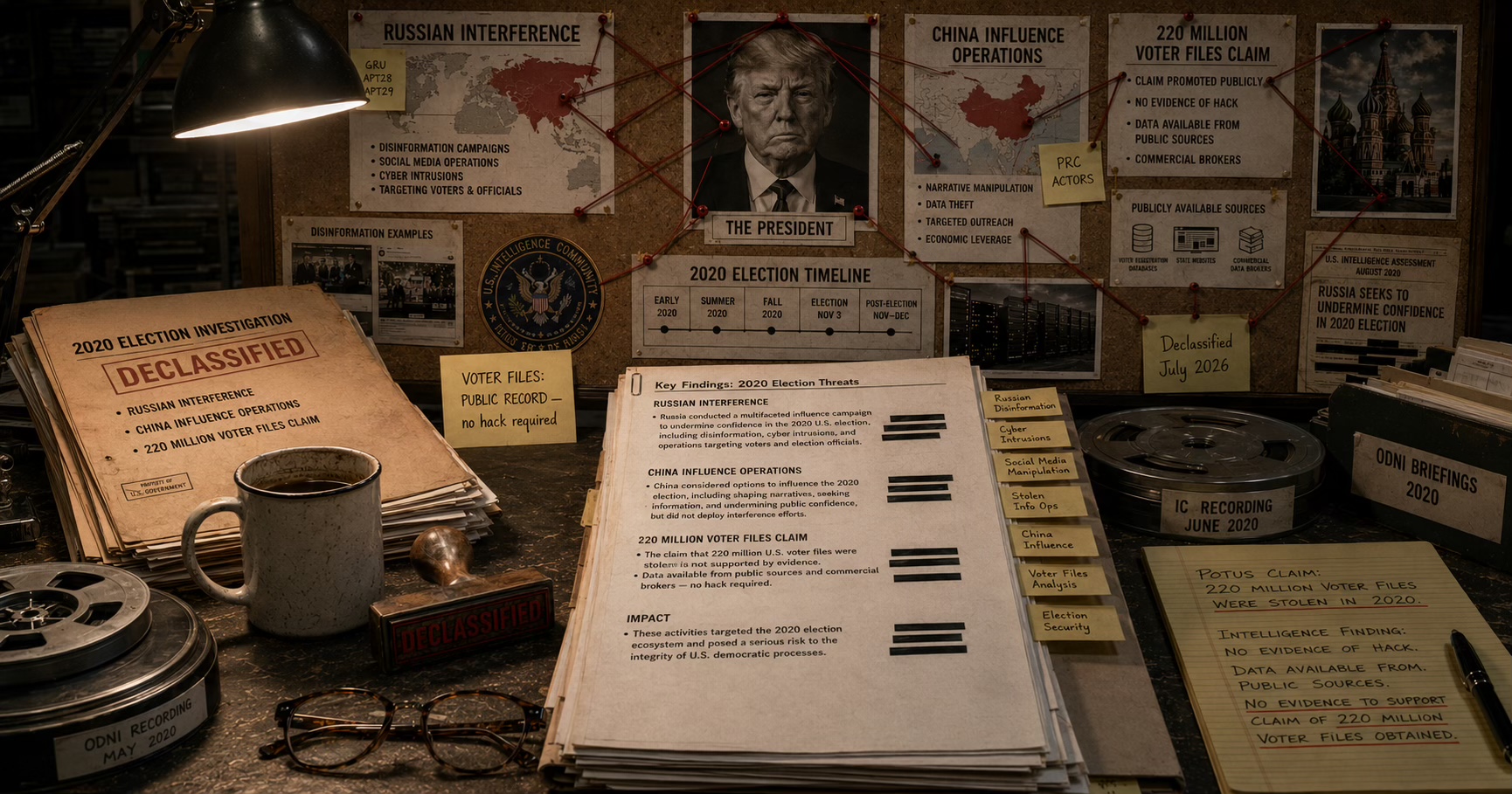
On the evening of July 16, 2026, President Trump stood in the White House East Room and told the country he was declassifying intelligence documents that proved something explosive: that China had carried out the largest compromise of election data in history, stealing 220 million American voter files, and that the intelligence community had kept this from the public.
That is a serious claim. It is also not what the documents say.
CNN’s review of the declassified material found it largely recycles information that has been known for years or was already reflected in the intelligence community’s own 2021 assessment, the one delivered under Trump’s own first administration by then-Director of National Intelligence John Ratcliffe, which found no indication that any foreign actor, China included, altered any technical aspect of the 2020 vote. None of the newly declassified material, per that review, supports the claim that any past election, including the one Trump lost in 2020, was manipulated by foreign interference or fraud. Senator Mark Warner, the top Democrat on the Senate Intelligence Committee, called the claim “so completely false” within hours of the speech: “our intelligence agencies unanimously agreed that China did not even try to change a single vote in the 2020 election.” Warner also pointed out the obvious irony that Ratcliffe, the man who oversaw that 2021 assessment as DNI, is now Trump’s own CIA director, and personally signed off on the finding the president spent his speech trying to undo.
The same 2021 assessment contains a finding Trump has never publicized the way he is publicizing this week’s China claim. It also concluded that Russia, acting on Vladimir Putin’s authorization, ran influence operations “aimed at denigrating President Biden’s candidacy and the Democratic Party, supporting former President Trump, undermining public confidence in the electoral process, and exacerbating sociopolitical divisions in the US.” As with China, the assessment found no indication Russia altered any technical aspect of the vote itself. But the same document Trump is citing now, selectively, to claim he was the target of foreign election interference, also says a foreign government worked to help him win.
There is also a simpler problem with calling this a “compromise.” As Warner put it plainly, most of the voter data in question, names, addresses, party registration, is already public record in most states: “You can buy these voter files. There’s no need to hack. I buy the Virginia voter files on a regular basis.” Describing its existence in Chinese hands as evidence of a historic hack, rather than evidence that a lot of routinely public information is, in fact, public, is not a security finding. It is a framing choice.
The president used the word “declassified” as though it settled something. What it settled, when reporters actually checked, is that the documents contradict him.
The rest of the speech does not fare better under the same scrutiny. Trump said the country’s voting systems are vulnerable to being “rigged and stolen,” and, as in every previous version of this claim going back to 2020, offered no evidence that a single vote was ever actually changed. Election security researchers point to the reason that claim has never survived contact with an actual audit: American elections run through thousands of separate local jurisdictions, the large majority of which use paper ballots that can be independently recounted by hand. A national conspiracy to alter an outcome would have to succeed, undetected, across thousands of independently run county offices at once. It has not happened, and no one in this speech claimed to have found a case where it did.
Alongside the address, the White House released a fact sheet claiming that more than 250,000 noncitizens are illegally registered to vote across California, Pennsylvania, New Jersey, and Nevada. The document offers no state-by-state breakdown of that number and no explanation of how it was calculated. It is based on the Department of Homeland Security’s SAVE database, which NPR has previously reported has a history of incorrectly flagging actual U.S. citizens as noncitizens. Nevada’s Secretary of State did not mince words: “These numbers are wildly speculative at best, and DHS has not shared anything that backs it up.” Pennsylvania’s Secretary of the Commonwealth, Al Schmidt, a Republican appointed by a Democratic governor, asked DHS to release its methodology so the claim could actually be checked. As of this writing, it has not. Independent research has consistently found real noncitizen voting to be, in practice, vanishingly rare.
None of this is incidental to what the speech was actually for. It built, deliberately, toward one ask: that Congress pass the SAVE America Act, Trump’s elections bill requiring photo identification to vote and documentary proof of citizenship to register. Senate Majority Leader John Thune has said the bill does not currently have the Republican votes to pass. The speech was, at least in part, an attempt to manufacture the public pressure to change that math.
This is worth naming plainly, because the mechanism matters as much as the specific claims. A president stood at a podium and used the word “declassified,” a word that borrows its authority from the idea that the intelligence community has verified something true and previously hidden, to describe material that the intelligence community’s own prior findings contradict. He paired it with a number from a federal database his own administration’s reporting record shows misfires, released with no methodology attached, and handed to reporters as settled fact anyway. A Democratic and a Republican election official, from different states, are both the ones asking DHS to show its work.
Call it what it is. This is not a president uncovering a hidden truth. It is a president using the machinery of government, the seal of declassification, the authority of a federal database, the primetime hour usually reserved for national emergencies, to relitigate an election he lost nearly six years ago, in service of a bill that would make voting harder for everyone in the meantime. The danger here is not that Americans will discover their elections were actually stolen. Every real check on that claim, from Ratcliffe’s own 2021 assessment to this week’s wire-service fact-checks to the state officials asking DHS a question DHS will not answer, points the other way. The danger is that a large enough share of the public will hear the word “declassified,” stop there, and never learn that the document behind it says the opposite of what they were told.