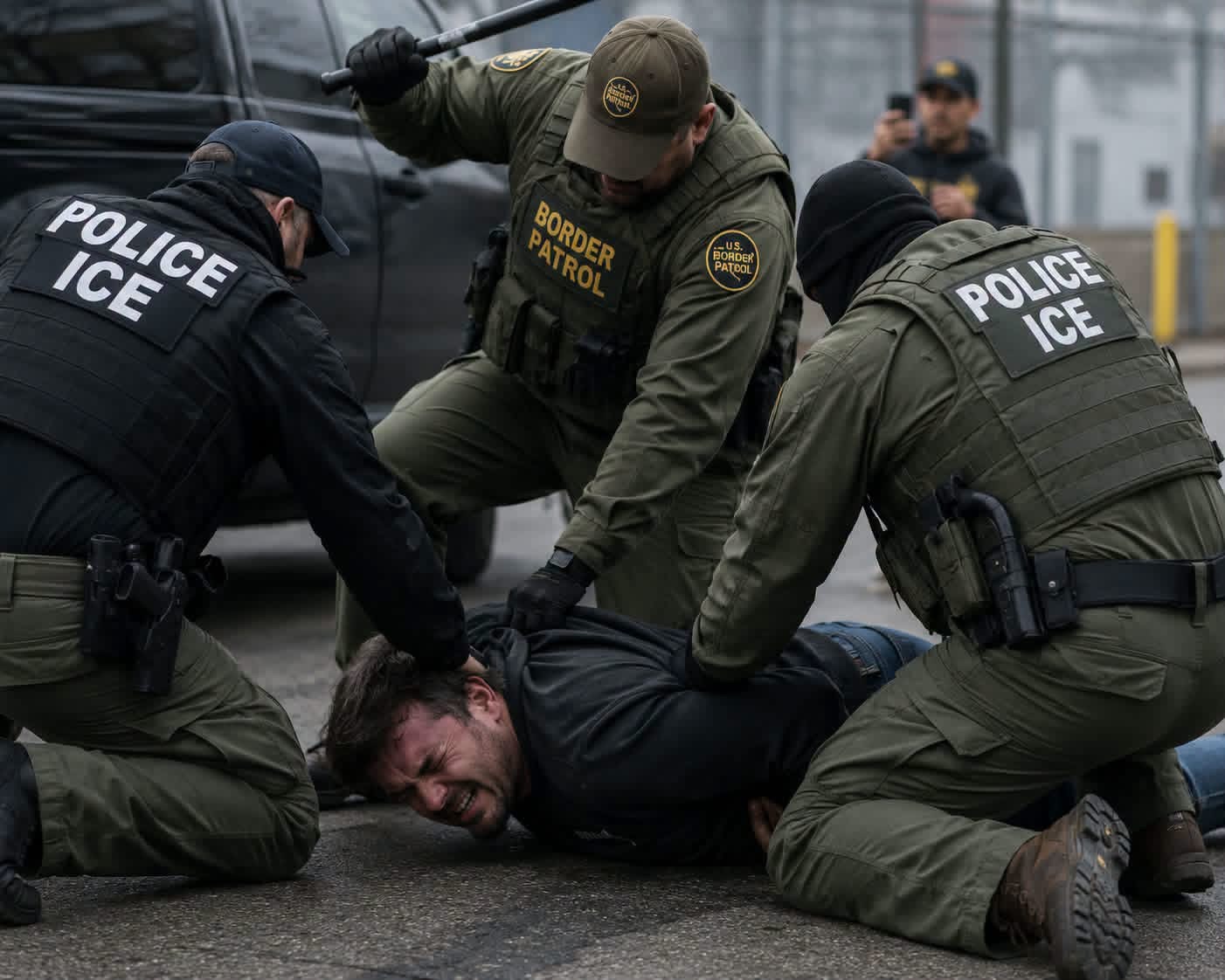
On July 13, 2026, an ICE officer shot and killed 26-year-old Johan Sebastián Durán Guerrero during an immigration-enforcement operation in Biddeford, Maine.
Durán Guerrero was not the person ICE had come to arrest. According to the Department of Homeland Security, he was shot after he attempted to flee in his vehicle and the officer feared for public safety.
That explanation does not justify the killing.
Attempting to flee is not a death sentence. It does not give an immigration officer the automatic right to fire into a moving vehicle and kill the driver. The government cannot transform panic, resistance or escape into a capital offense merely by attaching the words “public safety” to its press release.
And this was not an isolated event.
Six days earlier, on July 7, an ICE officer shot and killed 52-year-old Lorenzo Salgado Araujo during another attempted vehicle stop, this time in Houston. Salgado Araujo was not the target of that operation either.
DHS claimed that he rammed a government vehicle and tried to run over an officer. The men who were inside the van disputed that account, saying through their attorney that Salgado Araujo did not try to strike the agents and that the shooting was unprovoked. DHS has not publicly released body-camera footage supporting its version; officials later acknowledged that the agents were not wearing body cameras.
Two men killed in six days.
Two vehicle stops.
Two men who were not the people ICE had set out to arrest.
And in both cases, DHS reached immediately for the same justification: the vehicle became a threat, the officer feared for safety, and lethal force was therefore necessary.
That is a pattern.
It is also a warning.
After the second killing, ICE temporarily suspended most non-urgent vehicle stops nationwide so officers could receive additional training. That decision is an implicit admission that something was dangerously wrong with the way these operations were being conducted. Agencies do not halt a tactic nationwide immediately after two deaths because everything worked as intended.
The constitutional standard is not complicated. In Tennessee v. Garner, the Supreme Court held that police cannot use deadly force merely to prevent a suspect from escaping. An officer must have probable cause to believe that the person poses a significant threat of death or serious physical injury.
Fleeing alone is not enough.
That distinction matters because DHS’s public account of the Maine killing did not merely say that Durán Guerrero presented an imminent lethal threat. It said that he attempted to flee and that the officer fired out of concern for public safety. Homeland Security Secretary Markwayne Mullin reportedly gave Sen. Angus King a more aggressive version, saying the vehicle had been used as a weapon.
Those claims require evidence. They are not evidence themselves.
An agency that has just killed someone does not get to declare its own actions justified, withhold the underlying evidence and expect the public to treat its statement as a verdict. The public deserves video, witness testimony, forensic evidence and an investigation independent of the agency whose officer pulled the trigger.
Instead, DHS offers a familiar ritual: immediate exoneration, emotionally loaded language and an official narrative designed to make the dead person responsible for his own killing.
DHS has used the word terrorist freely against the people it considers enemies. It used that language against Renée Good after a federal immigration agent killed her in Minneapolis. The purpose was obvious: once the victim has been branded a terrorist, the public is no longer expected to ask whether killing her was lawful. Her death becomes not an event to investigate but an achievement to celebrate.
The same moral standard must apply to the government.
I am not using terrorism here as a narrow statutory term. I am using it in its plain moral sense: violence employed in pursuit of political objectives and used to intimidate a population.
The Trump administration has turned immigration enforcement into a political spectacle. Armed and masked agents descend on workplaces, neighborhoods and streets in unmarked vehicles. Arrests are filmed and publicized. Communities are shown, repeatedly and deliberately, what happens to people who are targeted, who resist or who try to get away.
Then people are killed.
Those killings do not affect only the people who die. They send a message to millions of immigrants and their families: Do not run. Do not resist. Do not question the men surrounding your vehicle. Comply immediately, even when they are masked, even when their vehicles are unmarked, even when you cannot tell whether you are being arrested or abducted, because hesitation may get you killed.
That is governance through fear.
When violence is used to force political compliance and intimidate an entire population, it is terrorism. A badge does not change the definition. A government seal does not cleanse the violence. A press release does not turn a killing into due process.
Government agents possess extraordinary authority. They can detain, imprison and, under narrowly defined circumstances, use lethal force. Those powers demand greater accountability, not automatic absolution.
Instead, DHS treats accountability as an attack on its officers and skepticism as sympathy for criminals. It demands that the public accept every invocation of “officer safety” without seeing the evidence. It labels its victims before investigators have examined the scene. It uses the language of terrorism to place the dead outside the boundaries of public compassion.
Now that language belongs to DHS too.
Johan Sebastián Durán Guerrero was shot after DHS says he attempted to flee.
Lorenzo Salgado Araujo was shot during another vehicle stop six days earlier.
Neither man was the target ICE had come to arrest.
Both men are dead.
DHS may call this immigration enforcement.
I call it state terrorism.