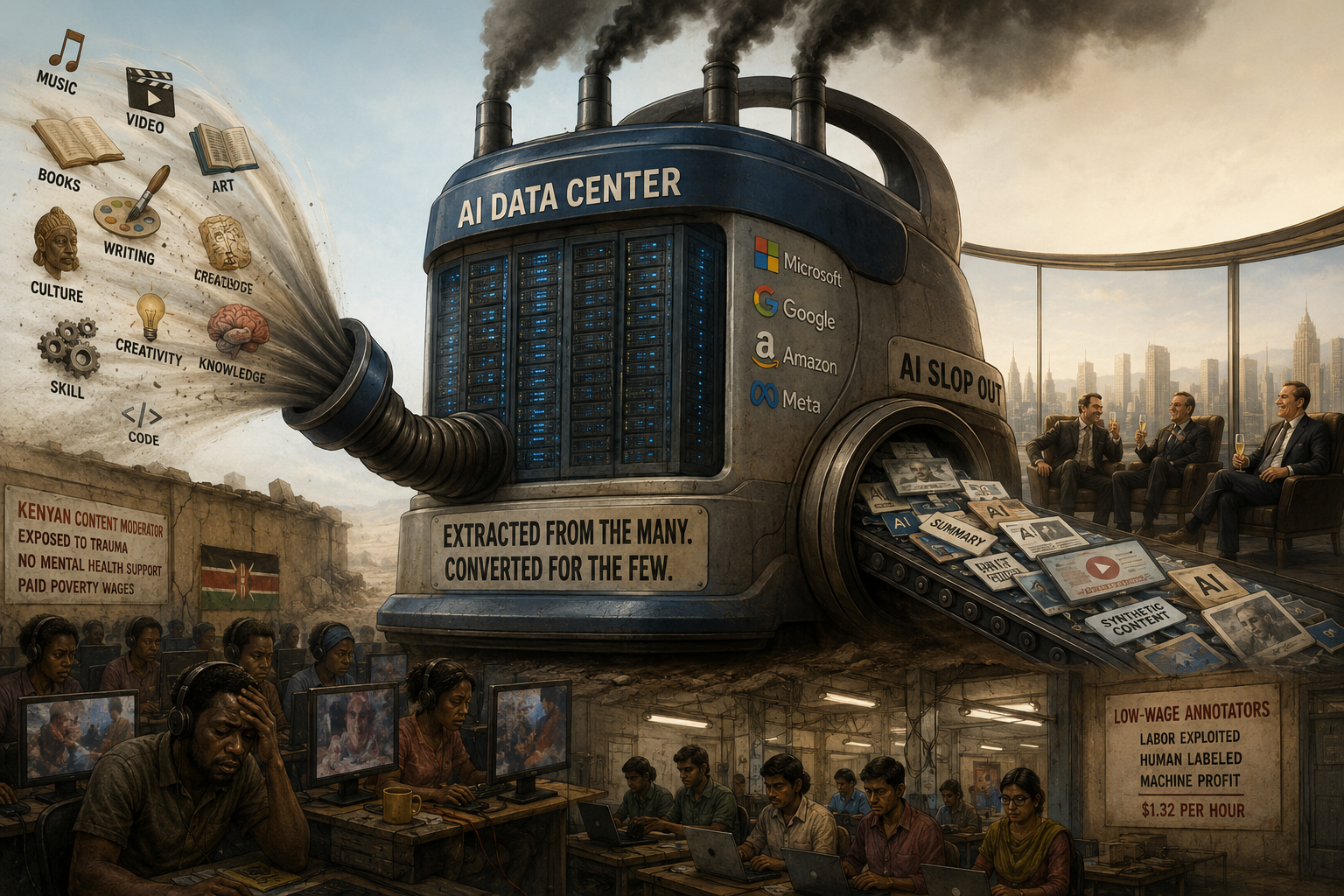
Call it innovation if you like. Dress it up in the language of progress, productivity, and democratized intelligence. Wrap it in keynotes, stock buybacks, and promises of abundance. But what we are watching is something older and uglier than that. The AI boom is not merely a technological revolution. It is a regime of extraction. It takes language, art, memory, labor, electricity, water, and public legitimacy from the many, then converts them into power for the few. That is why the right word is colonialism. Not because the metaphor is provocative, but because the structure is familiar.
Colonial systems do not begin by asking permission. They begin by declaring a frontier. In this case, the frontier is human culture itself. The books were already written. The paintings were already painted. The music was already composed. The code was already authored. The conversations were already had. AI firms simply arrived after the fact, scraped the territory, called the haul “training data,” and informed the dispossessed that this act of appropriation was somehow transformative. Reuters reported that Anthropic downloaded more than 7 million pirated books, and that a federal judge ruled the company’s use of those pirated copies to build a “central library” was not fair use — a finding that pushed Anthropic into a $1.5 billion settlement with authors. That is not homage. That is enclosure with a GPU budget.
The apologists always insist this theft is different because it is automated. But mechanized looting is still looting. The fact that the machine can remix the plunder at scale does not make the original seizure more legitimate. It makes it more dangerous. UNESCO has warned that AI governance must include transparency throughout the cultural value chain and fair remuneration for creators, especially in Global South countries. That warning exists because the industry’s current operating principle is brutally simple: seize first, negotiate later, and call any objection “anti innovation.”
And like every colonial order, this one depends on invisible labor. AI is sold as frictionless magic, but Reuters’ interview with Karen Hao laid out the reality in plain terms: companies contract workers in Global South countries for low wages to annotate data, moderate horrific content, and shape model behavior. Hao described Kenyan workers who were traumatized after moderating content for OpenAI’s systems. The fantasy sold in San Francisco is “intelligence without humans.” The business model, in practice, is humans hidden behind the interface, absorbing the psychological damage and receiving a tiny fraction of the wealth they help create. Empire has always preferred its servants to remain offstage.
Then there is the physical conquest. AI is marketed as if it floats in the cloud, untouched by material limits. In reality, it is devouring infrastructure. The IEA estimates that data centres used about 415 terawatt hours of electricity in 2024, around 1.5% of global electricity consumption, and projects that figure to reach about 945 terawatt hours by 2030 in its base case, just under 3% of global electricity use. Cooling alone can account for more than 30% of electricity demand in less efficient facilities. Yahoo Finance reported that Big Tech planned roughly $635 billion in AI related infrastructure spending for 2026. That is not a neutral upgrade to human knowledge. It is a massive redirection of land, power, capital, and water into private computational fortresses.
The defenders say the world has always built infrastructure for new industries. True. But colonialism is not defined by building things. It is defined by who bears the cost, who controls the system, and who is told to be grateful. The IEA notes that data centres are geographically concentrated and can be much harder on local grids because they cluster in specific locations. UNCTAD warns that AI’s benefits remain highly concentrated, that just 100 firms account for 40% of global corporate R&D spending, and that 118 countries are absent from major AI governance discussions. That is the heart of the scandal. The technology that is advertised as universal is being governed oligarchically. The countries and communities most likely to be shaped by AI are still being shut out of the rooms where its rules are written.
This is why the industry’s cheerful rhetoric about “global access” is so insulting. Access to what, exactly. Access to tools trained on other people’s work. Access to platforms owned by foreign firms. Access to services that can be withdrawn, repriced, censored, or geopolitically weaponized. UNDP warned in December 2025 that AI unmanaged could widen inequality between countries and erode decades of convergence. UNCTAD likewise warned that fewer than one third of developing countries even have AI strategies. Dependency is being sold as inclusion. That is classic colonial logic: you do not get sovereignty, only a subscription.
Even the promised prosperity is looking increasingly fraudulent. Goldman Sachs’ latest AI Adoption Tracker put net U.S. job losses at roughly 11,000 a month in the most exposed industries — driven by some 25,000 jobs eliminated monthly through AI substitution, partly offset by 9,000 added through augmentation — while UNCTAD warned that up to 40% of global jobs could be affected and that the benefits of automation often favor capital over labor. So the public is being asked to surrender culture, tolerate opaque extraction, subsidize infrastructure, and absorb labor displacement, all so a tiny number of firms can claim they are building the future. A future for whom. Certainly not for the workers replaced, the creators looted, or the communities told to accept higher resource strain in exchange for vague promises of modernity.
The most infuriating part is that none of this is inevitable. AI could be developed under radically different terms: licensed data, fair compensation, public compute, strong labor protections, transparent models, local language investment, and genuine participation from the countries and communities most affected. UNESCO, UNCTAD, and UNDP are all, in different ways, making the same argument: if governance remains exclusive and benefits remain concentrated, AI will deepen inequality rather than reduce it. The emergency is not that the machines are becoming too intelligent. It is that our political class is allowing old imperial habits to be reinstalled in digital form before the public has even learned how the system works.
So yes, say it plainly. AI is intellectual colonialism when it treats human creation as raw material to be seized. It is labor colonialism when it buries traumatized workers behind the myth of automation. It is infrastructural colonialism when it captures public resources for private model empires. And it is political colonialism when a handful of corporations and powerful states decide what knowledge systems the rest of the world will live inside. The urgency here is real. Once these asymmetries harden into institutions, contracts, grid plans, school systems, and legal precedents, they will be far harder to reverse. The time to object is before extraction becomes architecture.