
In April, three YouTube channels — Ethan Klein’s h3h3Productions, running under the name Ted Entertainment, along with Matt Fisher’s MrShortGameGolf and the channel Golfholics — filed a class action against Apple in federal court in California. The claim is not that Apple’s AI learned too much from their videos. It is that Apple built machinery specifically engineered to steal them. According to the complaint, Apple used Panda-70M — an academic dataset meant only as an index of links to YouTube videos — as a target list, then deployed virtual machines that rotated IP addresses at scale, so that when YouTube blocked one address the downloading simply continued on the next, feeding the training data behind the video-generation model described in Apple’s own research paper. Apple’s response, filed in July, is that none of this counts as theft because the videos were sitting in the open: “No password. No payment. No lock. No key.” That is not a research project that stumbled onto public video. That is a burglary tool with a corporate logo on the crowbar, defended in court by pointing out that the door was never locked.
This is not one company’s overreach. It is the same three plaintiffs running the identical playbook against nearly every major AI lab in the country. Ted Entertainment, Fisher, and Golfholics first sued Nvidia in December 2025, alleging the same rotate-and-download technique was used against another pair of academic pointer datasets to train Nvidia’s Cosmos video model. In January they added Meta and ByteDance, accused of building their “Make-A-Video” and “MagicVideo” models the same way, followed weeks later by Snap. By April they had filed against OpenAI, alleging its Sora model was trained through the same circumvention, and against Apple, and days after that against Amazon in Seattle over its Nova Reel model — a suit Amazon is now trying to get dismissed by arguing the plaintiffs’ claims about which datasets it used are “entirely speculative.” Seven companies, one theory: not “your AI learned from my video,” which courts have mostly allowed, but “you built a tool to defeat the lock I put on my video,” which is a narrower question a court might actually answer against them.
The practice runs well past these seven defendants. An investigation reported by The Atlantic found Big Tech firms — among them Meta, Microsoft, Nvidia, Amazon, ByteDance, Snap, Tencent, Apple, and Anthropic — have scraped an estimated 15.8 million YouTube videos from more than two million channels using at least thirteen separate datasets. One creator caught up in it, a woodworker named Jon Peters, put the fear plainly: “I think everything’s gonna get stolen… Do I quit, or do I just keep making videos and hope people want to connect with a person?” That is the same question asked by every author whose book ended up in Anthropic’s central library, and every Kenyan moderator paid two dollars an hour to make OpenAI’s products safe for the rest of us. The frontier is always declared over someone else’s work first.
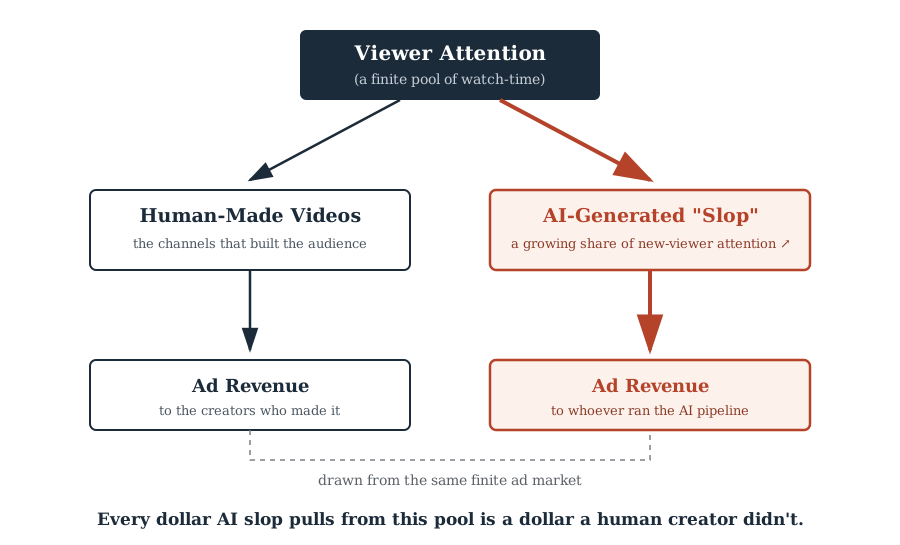
The theft is only half of it. The other half is that the product built from that theft now competes with the people it was built from, on the very platform where they built their audience. In January, YouTube terminated or wiped sixteen of its biggest “AI slop” channels in a single sweep — thirty-five million subscribers, 4.7 billion lifetime views, an estimated $9.8 million in yearly ad revenue, gone in a week. A separate audit by the video-editing company Kapwing scanned the top 100 trending channels in every country and found 278 built almost entirely on AI slop, pulling a combined 63 billion views and an estimated $117 million a year; the same audit found that of the first five hundred Shorts recommended to a brand-new account, a fifth were pure AI slop and a third were slop or algorithmic “brainrot” more broadly. That is what a new viewer meets before they ever find a human being. What’s missing, and should be said plainly, is proof this is actually cutting into what an individual working creator earns per video — YouTube doesn’t publish that data, and nobody outside the company has shown the money moving from human channels to slop channels rather than simply being new inventory the ad market absorbed. The theft is documented. The competitive damage is, for now, inferred.
YouTube’s own posture here is a small case study in corporate double-talk. In his January letter to creators, CEO Neal Mohan named “managing AI slop” a top priority for 2026 — in the same letter where he noted that, on average, more than a million channels used YouTube’s own AI creation tools daily in December. Those are two different claims wearing one company’s face: we will police the AI content we did not build, while expanding the AI content we did. The platform’s actual rules reflect that split. A disclosure policy requires creators to label realistic AI-altered depictions of real people; a separate “inauthentic content” policy — the one actually used in the January purge — targets mass-produced, templated video with no original value added. Neither rule touches the scraping itself. YouTube will take down the slop channel built on stolen footage. It has shown far less enthusiasm for asking who stole the footage.
That is because the parent company has the same conflict of interest running through its own product line. At Google I/O this year, YouTube rolled out “Ask YouTube,” which lets a viewer get an AI-generated answer pulled from inside a video without watching it. That is precisely the complaint web publishers have been making about Google’s AI Overviews for two years — traffic and attention captured at the summary layer, upstream of the page or the video that took real work to make. The European Commission has opened a formal antitrust investigation into whether Google abused its dominance by using exactly this kind of content, web publishers’ and, explicitly, material uploaded to YouTube, to fuel its AI products without consent or compensation; Google faces fines of up to ten percent of global revenue if the Commission finds against it. So the same corporate family hosts the platform, enforces against outside scrapers, runs the in-house AI tools creators are pushed toward, and is now piloting a feature that skims value off the videos before the viewer ever presses play. Every layer of the transaction has the same owner.
The pushback that exists is real but narrow. More than 200 organizations and experts, organized by Fairplay, demanded in April that YouTube ban AI slop from YouTube Kids outright, citing slop channels aimed at children that clear more than $4.25 million a year. That is a fight about what algorithms show to seven-year-olds, not about what tech companies took from the adults who made the platform worth building an audience on in the first place. Nebula, the creator-owned streaming service, has staked out a cleaner position: it won’t build its platform on generative tools trained on unethically sourced data, saying it wants creators to feel secure it isn’t looking to “sell their work to the plagiarism factory.” But that is a curation choice for one small alternative platform, not a rule anyone is imposing on YouTube itself. For now, the only real teeth belong to the lawsuits.
Which is why the h3h3 group’s campaign is worth watching more closely than the rest. Two years of fair-use argument over AI training data have mostly gone the industry’s way, including in the very ruling that forced Anthropic into its own book-piracy settlement. The DMCA claims against seven of the biggest names in AI do not ask a judge to decide whether training on video is transformative. They ask whether a company built a tool to defeat a copyright-protection system, which is a much narrower and much less forgiving question. If it works, it will be because the law finally stopped asking whether the theft was creative and started asking whether it was, simply, theft. AI is intellectual colonialism whether the raw material is a shelf of pirated novels or a decade of uploads from creators who never got asked. YouTube is just the chapter where most of us can recognize the victims by name.