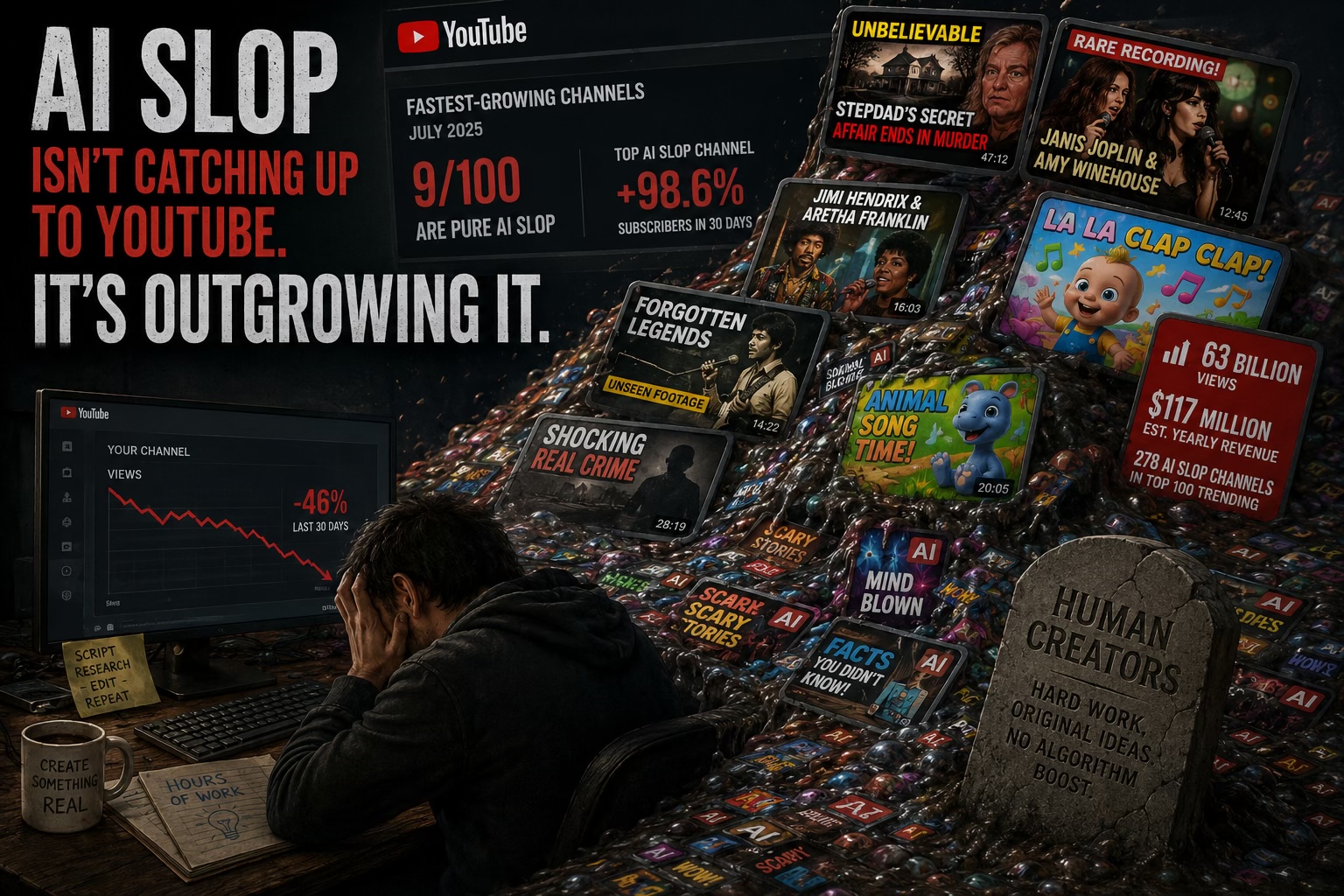
Ask how much of YouTube is AI slop and you get a snapshot: a report, a percentage, a moment in time. Ask a sharper question — how fast is it growing relative to everything else — and the picture goes from concerning to alarming. In July 2025, The Guardian ran YouTube’s own analytics data through the tracking firm Playboard and found that of the platform’s 100 fastest-growing channels that month, nine were pure AI slop: no human on camera, no original reporting, no research, just prompts turned into video at a pace no person could match. Three of those nine gained nearly all of their subscribers in that single month, one growing its audience by 98.6 percent in thirty days. That is not a rounding error in the ecosystem. That is the ecosystem’s fastest-growing part.
The people whose job is to actually compete against that growth are noticing. Craig Billings, a science YouTuber who posts under the name Doctor NOS to 1.7 million subscribers, says other creators have started messaging him for advice because AI slop channels are “getting way more views than I am on YouTube.” The uncomfortable detail is who’s calling: not other AI operators, but human creators who have never shown their faces on camera, now getting mistaken for the problem. When YouTube tuned its algorithm to reward videos where a real person’s face is visible on screen, hoping to starve the slop of distribution, it didn’t actually detect AI. It detected facelessness — penalizing exactly the audio-essay and documentary-style creators who were making faceless human content for a decade before generative video existed, while sufficiently face-forward AI content keeps sliding through.
Sometimes the copying is more direct than an algorithmic side effect. A channel called True Crime Case Files spent months publishing videos in the exact house style of established true-crime channels like JCS and Explore With Us — narrated documentary breakdowns of shocking cases — except the cases were invented, the narration was AI-generated, and the crimes never happened. Its most-watched video, a script half-written by ChatGPT about a stepfather’s secret affair with his stepson ending in murder in Littleton, Colorado, pulled in nearly two million views before a Denver Post reporter — fielding calls from readers asking why the paper hadn’t covered it — found there was no such crime. The creator later admitted he stopped disclosing the AI involvement once he noticed viewers engaged less with videos that carried the label. YouTube eventually terminated the channel — not for inventing crimes and impersonating a real journalistic genre, but for violating child-safety policy in the process. The fabrication itself was never the violation.
The fabrication travels well outside true crime. A channel called Lost Tapes Archives brands itself as the home of “rare recordings and forgotten reels from the greatest legends in music history” — supposed unreleased sessions from artists who never recorded them. One video presents Janis Joplin and Amy Winehouse performing together; Joplin died in October 1970, thirteen years before Winehouse was born. It isn’t an isolated slip — another video credited as “Jimi Hendrix & Aretha Franklin” carries a thumbnail reading “Jimi Hendrix & Big Mama Thornton,” the title and the artwork unable to agree on who is supposedly playing. None of that has stopped the catalog from finding an audience: a fabricated “Janis Joplin & Jimi Hendrix” session alone has pulled more than 450,000 views. The tell isn’t that the fakes are bad. It’s that nobody making them needed a real collaboration, a real death date, or even a consistent thumbnail to get paid for one.
The same playbook runs, with less subtlety, in children’s programming. A Bloomberg investigation found creators openly coaching each other on the formula: ask ChatGPT for “simple, repetitive” song lyrics full of nonsense syllables like “la la” and “clap clap,” feed the output into an AI video generator, and collect the ad revenue from toddlers who can’t tell the difference. The advocacy group Fairplay found the top channels running this formula clear more than $4.25 million a year combined. Legitimate, human-vetted alternatives built specifically to compete with YouTube for young children — Sensical, Meevee — exist and are safer by design, and neither has managed to dent the incumbent’s audience. As one children’s-media professional put it, there is “a graveyard full of failed attempts to create a safe YouTube alternative.” The slop didn’t have to be good. It just had to arrive first, in volume, forever.
Zoom out and these stop looking like edge cases and start looking like the baseline. Kapwing’s own audit of the platform found 278 channels across the global top-100-trending lists built almost entirely on AI slop, pulling a combined 63 billion views and an estimated $117 million a year — and that of the first 500 Shorts recommended to a brand-new account, a fifth were pure AI slop and a third were slop or algorithmic “brainrot” more broadly. None of that is hidden in a corner of the platform. It is what a new viewer meets on the way in, before they ever find a person.
None of this is close to peaking. The global market for AI video-generation tools was worth roughly $788.5 million in 2025; industry analysts at Grand View Research expect it to grow past $3.4 billion by 2033, a compound growth rate above 20 percent a year, as tools like Google’s own Veo 3 make convincing video cheaper and faster to fabricate with each new release. Every improvement in the underlying model is, from a platform-integrity standpoint, an improvement in the slop’s disguise.
YouTube’s response, as covered here previously, is to police the symptom it finds administratively convenient — mass-produced, templated video with no disclosed AI involvement — while leaving the deeper mechanism alone: an algorithm that rewards volume and upload frequency over origin, on a platform whose own in-house AI tools were used by more than a million channels a day in December. A true-crime channel that invents murders, a music channel that fakes duets between artists who never met, a kids’ channel that hypnotizes toddlers with nonsense syllables, and a faceless science creator losing ground to all three are not four separate problems. They are the same problem, measured at four different distances from the camera. The fastest-growing thing on YouTube right now is not a creator. It’s a method for skipping what creators actually do.