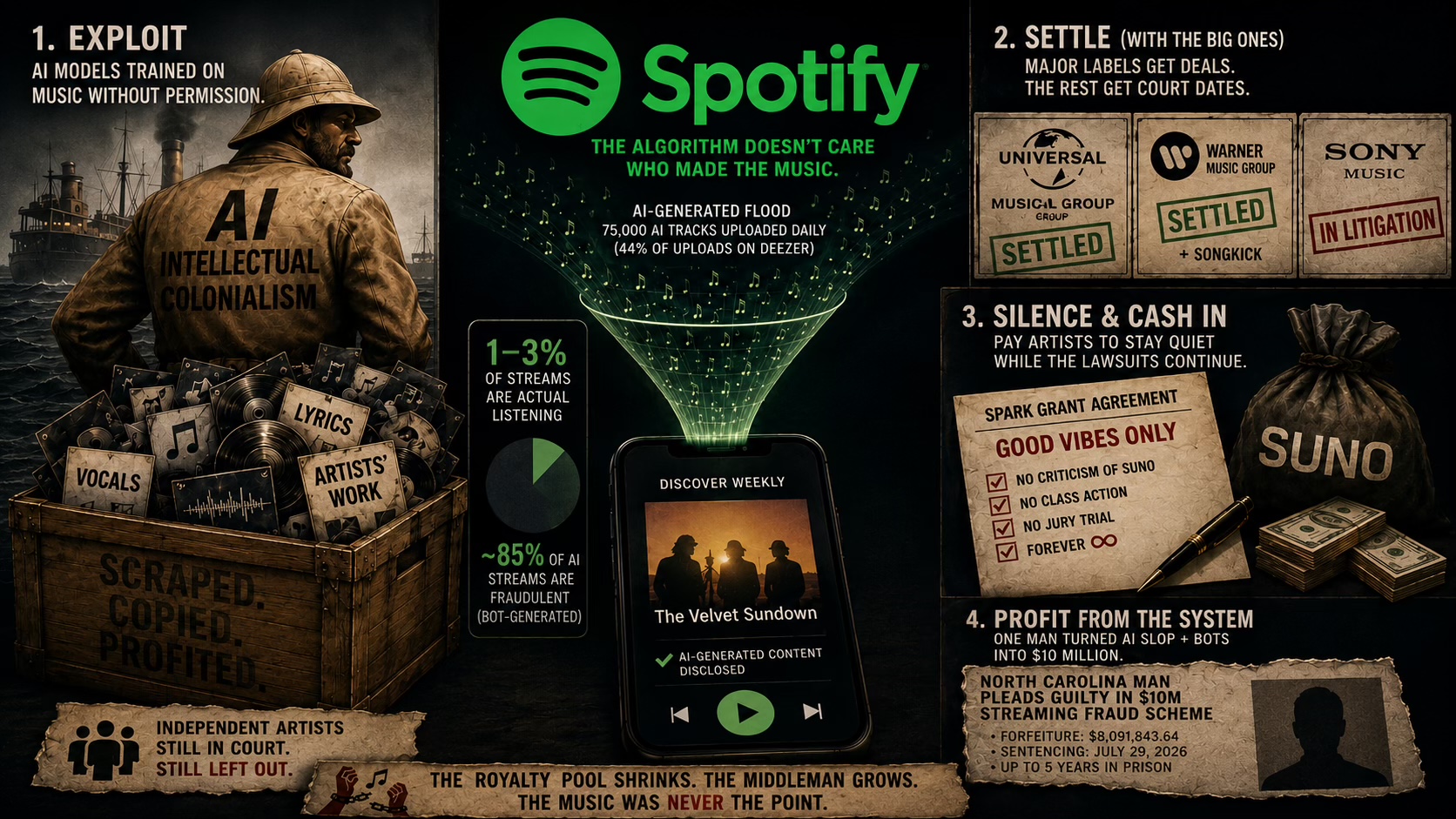
In the summer of 2025, a retro-rock four-piece called The Velvet Sundown climbed past 1.4 million monthly listeners on Spotify, riding heavy rotation on Discover Weekly and a string of editorial-adjacent playlists. There were no interviews, no tour dates, no verifiable members. When Rolling Stone pressed, a pseudonymous “spokesperson” first insisted the band was real, then admitted the music, vocals, and lyrics had been generated on Suno. “It’s marketing,” he said. “It’s trolling.” NBC News had already documented the mechanics of the rise: high completion rate, low skip rate, sub-genre coherence, exactly the signals the recommendation algorithm is built to reward, fed by a catalog that could be produced at a volume and cadence no human band could match. Once exposed, The Velvet Sundown wasn’t removed. It complied with Spotify’s disclosure rules and stayed up, just without the algorithmic push.
That is the small, resolved version of a much larger story. The same extraction machine that scraped books and art, YouTube videos, code repositories, and human attention itself has been scraping music, and the scale dwarfs one fake band. Deezer, which built a patent-pending AI-detection tool specifically to track this, has published the growth curve in public: 10,000 AI-generated tracks a day when the tool launched in January 2025, 30,000 by September, 50,000 by November, 60,000 by January 2026, and 75,000 a day by April 2026, now 44 percent of everything uploaded to the platform daily. Spotify has never published a comparable figure. What it has published is an admission that it removed 75 million spam and AI-flooded tracks over the previous year and tightened its rules to require disclosure of AI-generated content and bar unauthorized voice cloning. Disclosure, not removal, remains the actual policy: Spotify does not ban AI music, it just asks that you say so.
The sharper story is what happened when the companies making that flood possible got caught. Suno and Udio spent roughly two years training their models on catalogs of copyrighted music with no licenses at all, an operation a Forbes analysis of the resulting legal fallout summarized under the headline “Launch, Train, Settle: How Suno And Udio’s Licensing Deals Made Copyright Infringement Profitable.” The pattern the piece describes is now familiar from every other chapter of this series: build the product on material you don’t own, grow fast enough that dismantling it becomes more expensive than paying for it, then let whoever has the resources to sue you negotiate a price. Universal Music Group settled with Udio in October 2025. Warner Music Group settled with Udio that November and, weeks later, with Suno itself, a deal sweetened by Warner selling Suno its concert-discovery platform, Songkick, as part of the arrangement. Sony Music is still in litigation with both companies. So is Universal, separately, against Suno alone, in a suit joined by Concord and ABKCO that expanded this year from 560 songs to 61,026, pushing the theoretical damages from roughly $84 million past $9 billion.
None of that litigation has slowed Suno down. In June 2026, still a defendant in multiple active copyright suits, the company raised another $400 million at a $5.4 billion valuation, up from $500 million just two years earlier. The settlements explain why investors aren’t worried: the two companies with the leverage to make the lawsuits expensive have already been paid. Independent artists suing both companies allege their catalogs were scraped just as extensively as major-label material, and they had no seat at either settlement table.
They are still fighting for one in court. Country musician Tony Justice and his label, 5th Wheel Records, filed proposed class actions against both companies in June 2025 on behalf of every independent artist whose recordings had been streaming since 2021, seeking damages of up to $150,000 per infringed work. This spring, Hagens Berman, the firm that won the $260 billion tobacco settlement, joined the fight against Udio. As of this writing, both cases remain unresolved: no ruling on Suno’s motion to dismiss, no settlement anywhere in sight for the artists the major labels’ deals left out.
While that case sits open, Suno launched something else: an incubator called Spark, offering independent artists grants worth thousands to tens of thousands of dollars. Buried in the fine print is a clause headed “Good Vibes Only,” under which any artist who accepts the money agrees never to publicly criticize Suno, in any form, for any reason, with no expiration date. The agreement also waives the right to a jury trial or to join a class action, the exact mechanism the artists still in litigation are relying on. A company being sued by independent artists for using their work without consent is now paying a different set of independent artists to promise, permanently, that they will never say anything negative about it.
Spotify insists none of this is actually costing anyone money. Because streaming royalties come from a shared pool, subscription revenue divided by total plays across the platform, every stream captured by an AI track is, in principle, a stream not paying a human artist. Independent artists have the most exposure to that math: they generated roughly half of the $11 billion Spotify paid out in royalties in 2025. Yet Spotify’s own head of artist and industry partnerships has publicly denied any dilution is occurring, calling AI-generated listening “infinitely small.”
Deezer’s own numbers complicate that denial in an unexpected way. Despite 44 percent of daily uploads now being AI-generated, actual listening to that material stays low, only 1 to 3 percent of total streams. The real danger isn’t that audiences are choosing synthetic music over human artists in large numbers. It’s what happens to that thin slice of AI streams: Deezer classifies roughly 85 percent of them as fraudulent, generated not by listeners but by bots. The infrastructure isn’t primarily competing for ears. It’s built to be gamed.
None of this is abstract for the people actually making the music. CISAC, the global federation representing more than five million music and audiovisual creators, projects generative AI will cut creators’ income by 24 percent by 2028, a cumulative €10 billion loss, driven by two forces at once: unlicensed use of their work as training data, and AI-generated output substituting directly for the paid work they used to do. That substitution lands hardest on the session-and-library economy that used to fill the gaps between bigger gigs, the composers who scored ads, jingles, and mood-playlist filler for a living, work that AI-generated tracks can now produce at close to zero marginal cost. PRS for Music, the UK collecting society representing more than 180,000 songwriters, composers, and publishers, surveyed over 2,630 of its own members in 2026 and found 79 percent now worried about AI-generated music competing directly with their work, up five points from 2023, and 76 percent agreeing AI has the potential to hurt their livelihoods, up seven points. The same survey found members had grown far more informed about how the technology actually works since the last one, and that greater understanding made them more anxious, not less. In February 2026, a coalition of artist-rights groups, including the Music Artists Coalition and the Artist Rights Alliance, joined by musicians such as David Lowery, published an open letter accusing Suno directly: “Suno built its business on our backs, scraping the world’s cultural output without permission, then competing against the very works exploited.” The same letter warned that Suno had not “demonstrated persuasively that its platform does not, in practice, serve as a scalable input into streaming-fraud schemes,” five months before Michael Smith showed exactly what that looks like at scale.
This is the pattern this series named enshittification in its fourth chapter, Cory Doctorow’s term for a three-stage decline: a platform is good to its users, then it gets worse for users to benefit the businesses that pay to reach them, then it gets worse for those businesses too, once the platform claws back whatever value is left for itself. Spotify’s original pitch to musicians was a better deal than piracy, something instead of nothing. What working musicians are left with now is a shrinking share of a pool that a flood of near-free AI content keeps diluting, sold to them, still, as the responsible option.
Michael Smith spent seven years proving the artist-rights letter right. From 2017 to 2024, the 54-year-old from Cornelius, North Carolina, built a fraud operation on top of the same tools now on the market for anyone: he bought hundreds of thousands of AI-generated songs from a co-conspirator, uploaded them, then ran armies of bot accounts that streamed them continuously, extracting royalties on music no person ever chose to hear. Prosecutors say he pulled in more than $10 million before he was caught, in what the Justice Department is calling the first federal criminal prosecution of streaming fraud in the United States. He pleaded guilty, agreed to forfeit $8,091,843.64, and is scheduled to be sentenced on July 29, 2026, facing up to five years in prison. Smith isn’t an aberration the system failed to anticipate. He is what a royalty pool with no per-track scrutiny and an unlimited supply of free content was always going to produce, once someone worked out how to combine the two.
Put the pieces next to each other and the shape is the one this series keeps finding. Scrape the work of people with no leverage to stop you. When someone with leverage finally sues, pay them and only them, and call the resulting arrangement responsible licensing. Let everyone else’s claims sit in court for a year while your valuation climbs anyway. Offer the people you’re still being sued by a grant, with a clause that asks them to stop talking about it, forever, as a condition of the money. And underneath all of it, leave the infrastructure open enough that a man in North Carolina can turn the same free generation into ten million dollars before anyone notices. The extraction was never really about the music. It was about who gets to keep what the music was worth, and by now the answer is not close to a surprise.