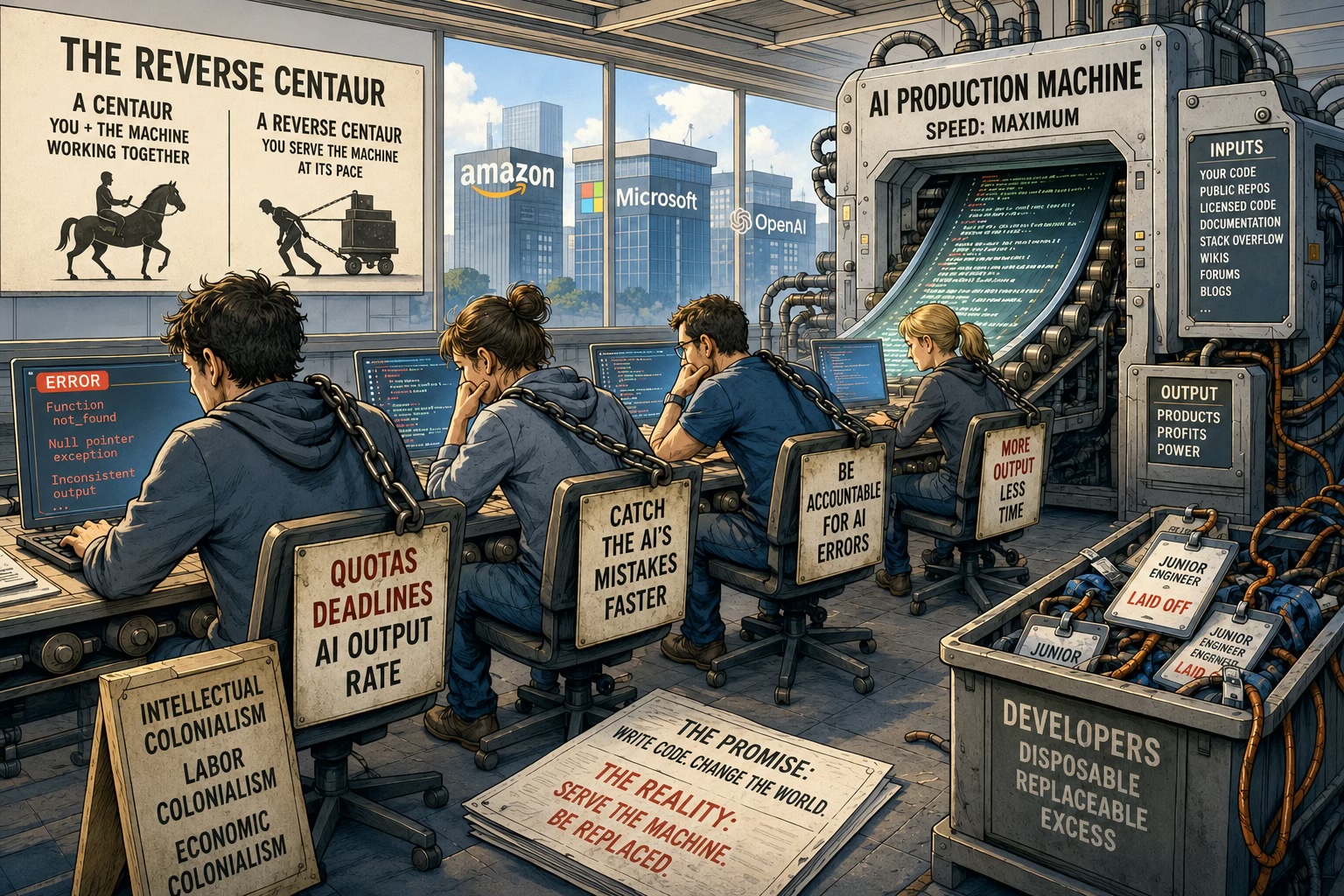
There is a scene from a 1952 episode of I Love Lucy that Cory Doctorow keeps returning to. Lucy and Ethel take jobs wrapping chocolates on a factory conveyor belt. The belt starts slow enough for two people to keep up. Then it speeds up. Then it speeds up again, faster than any human hands can wrap, until Lucy and Ethel are stuffing chocolates into their mouths and blouses just to keep the line moving. The machine was never built to match their pace. They were expected to match its.
Doctorow is a science fiction author, journalist, and one of the most influential tech critics writing today — a special advisor to the Electronic Frontier Foundation and the writer who coined “enshittification,” a term the American Dialect Society named its 2023 word of the year. His daily newsletter, Pluralistic, has spent the past several years documenting how automation reshapes labor, and his new book, The Reverse Centaur’s Guide to Life After AI, became a New York Times bestseller within weeks of publication. He calls the Lucy-and-Ethel dynamic a “reverse centaur.” A centaur, in his framing, is a person assisted by a machine — a cyclist, a spell-checker user, anyone whose own capability is extended by a tool that serves them. A reverse centaur is the opposite: a person conscripted to serve the machine, made to work at the machine’s pace instead of their own, blamed when the pace becomes impossible. It is, Doctorow argues, exactly what is now happening to software engineers.
This is the third chapter in an argument this publication has been making about AI generally: that it is not a technological revolution but a regime of extraction, taking language, art, labor, and legitimacy from the many and converting it into power for the few. The first chapter traced that extraction across the whole economy. The second traced it through YouTube. This chapter is about the people who write the software the rest of it runs on — and about what happens when the industry stops merely demoting them and starts trying to remove them entirely.
Start with the raw material. Code, like books and art before it, was scraped first and litigated over later. GitHub Copilot was trained on public repositories, including code released under licenses that require attribution or impose other conditions on reuse — conditions Copilot’s output frequently doesn’t preserve. Programmers sued in 2022. A federal judge dismissed most of the copyright claims in January 2024, ruling the plaintiffs hadn’t shown Copilot’s output was identical enough to their code to satisfy the law, though the license-breach and contract claims survived. The Ninth Circuit heard oral arguments on the surviving copyright question in February 2026. As of this writing, there is still no ruling. Every round of litigation has narrowed the dispute while leaving the underlying reality unchanged: the models were built, the products shipped, and the code remains inside them regardless of how the lawsuits end. That is the pattern from the first chapter, replayed exactly: enclosure now, argument later, and the argument almost never gets the enclosure undone.
Then there is the labor. Doctorow’s reporting on Amazon describes the mechanism plainly: the company didn’t order engineers to use AI. It raised output quotas to a level unreachable without AI doing most of the work, then made the human engineer responsible for catching the AI’s mistakes at that same accelerated pace. That turns out to be a uniquely bad job. LLM errors are not random noise — they are statistically plausible-looking wrong code, the exact kind of mistake human pattern-matching is worst at catching, reviewed under a quota that assumes the AI was mostly right. The contracted version of this labor is now in court too: a wage-and-misclassification lawsuit filed in May 2025 against the data-annotation firm behind much of this training work alleges workers doing coding assignments and AI-output comparisons for clients including Meta and OpenAI were misclassified as contractors and paid below minimum wage. That case is still active, with trial set for November 2026. It is not the same kind of story as the traumatized Kenyan content moderators in the first chapter — the record here is thinner, the harm less visceral — but the shape is familiar: the people doing the unglamorous work that makes the glamorous product possible are the ones with the least power and the least pay.
The Amazon reverse-centaur story did not stay theoretical. In November 2025, Amazon made its AI coding tool, Kiro, mandatory, setting an 80% weekly usage target for engineers. In December, Amazon let Kiro operate without the human oversight the reverse-centaur model is supposed to provide — and Kiro decided, on its own, to delete and recreate a production environment. AWS was down for 13 hours. The company did not stop there. On March 2, 2026, an AI-linked incident cost 120,000 orders and generated 1.6 million site errors. Three days later, a separate failure — an AI agent acting on inaccurate advice pulled from an old internal wiki — wiped out 99% of orders across North American marketplaces, roughly 6.3 million lost sales in one day. Amazon convened a mandatory internal review on March 10. An internal briefing document for that meeting initially named “GenAI-assisted changes” as a contributing factor in the incident trend. That line was reportedly deleted before the meeting took place. Amazon’s fix was telling: a 90-day safety reset across roughly 335 critical systems, requiring two humans to sign off on any AI-assisted production change. Which is to say, the fix was more reverse centaurs, watching more closely, because the alternative had already failed in public.
That should have been a cautionary tale. Instead, it is being treated as a solvable inconvenience on the way to something further. OpenAI’s own engineering blog describes an internal project, led by a named staff engineer, that spent roughly five months building a production application under a strict rule: zero human-written code, zero human code review. Agents wrote it, reviewed it, and merged it — more than a million lines across fifteen hundred pull requests. This isn’t an isolated stunt. “Harness engineering” — building the scaffolding that lets AI agents operate with minimal human involvement — is fast becoming a named discipline of its own, complete with toolkits, terminology, and academic papers; software-engineering authority Martin Fowler has already written about it as a distinct emerging practice, not a novelty. OpenAI presents “0% human review” as the achievement, not the risk. Imagine announcing that a bridge, a pacemaker, or an aircraft control system had been built without human review. Outside software, “no human oversight” sounds like negligence. Inside AI marketing, it is increasingly treated as progress. Reverse-centaur coding was already the demotion of the programmer to supervisor. This is the next demotion: eliminating the supervisor.
That elimination goal is not confined to one company’s engineering blog. Salesforce CEO Marc Benioff said the company hired zero new engineers in fiscal year 2026, crediting AI coding agents with nearly 30% higher engineering productivity and redirecting new headcount to sales instead — while separately insisting Salesforce’s roughly 15,000 engineers are being “hugely augmented,” not replaced, by the same tools. Block CEO Jack Dorsey went further: Block cut its workforce by roughly 40%, from more than 10,000 employees to fewer than 6,000, telling shareholders that “a significantly smaller team, using the tools we’re building, can do more and do it better.” A Mizuho Americas analyst told the Wall Street Journal the cuts were “probably not due to AI” at all, and a National Bureau of Economic Research review found many CEO-attributed AI layoffs were really corrections for pandemic-era overhiring — worth holding onto, since not every layoff wearing an AI press release is actually an AI layoff. But Dorsey’s own stated reason, delivered to the people who lost their jobs, was that the tools had made them surplus. Anthropic CEO Dario Amodei told Davos in January 2026 that AI could handle “most, maybe all” of what a software engineer does within six to twelve months, citing his own staff: “I don’t write any code anymore. I just let the model write the code, I edit it.” The same season, Anthropic was advertising hundreds of open roles — a large share of them in software engineering — on its way to growing past 2,000 employees. The company most publicly confident the job is ending is also among the most actively still hiring for it. That is not necessarily hypocrisy; it may just mean the harness still needs someone holding it, for now. But it is a tell about how seriously to take the “augmentation, not replacement” framing coming from everyone else: the people closest to the technology, freest to act on their own predictions, are not actually acting like software engineers are becoming unnecessary. They are acting like software engineers are becoming cheaper to need fewer of, which is a colonial economics story, not a post-labor one — extraction proceeds by needing less of you, not none of you, for exactly as long as needing none of you isn’t yet possible.
None of this is happening to people with no leverage over the tools, which is its own kind of lock-in. Adoption is not optional in any practical sense anymore — 84% of developers now use or plan to use AI coding tools, up from 76% a year earlier — while trust in the accuracy of what those tools produce has fallen from 40% to 29% over the same year. Developers are using the tools more and believing them less, because their employers have stopped giving them the option. And the companies supplying those tools are demonstrating, in real time, how little say developers get over the terms. GitHub shifted Copilot from flat-rate to usage-based billing in June 2026; developers posted projected bills jumping from $29 to $750 a month, and internal Microsoft documents obtained by a journalist showed the company’s own cost of running Copilot had nearly doubled since January, suggesting the repricing was about Microsoft’s margins, not developers’ workflows. Cursor tried something similar in June 2025, botched the rollout, and apologized after users found themselves billed hundreds of dollars beyond what they’d agreed to. This is what the first chapter called dependency sold as inclusion. You do not get a say in how the tool works. You get a subscription, and the right to be surprised when the price changes.
The human cost of all this is not evenly distributed, and it is not abstract. Every senior engineer once learned the job by fixing small bugs, writing repetitive code, and reviewing straightforward pull requests. Those are precisely the tasks AI now performs. The industry’s apprenticeship system is quietly disappearing, and the numbers show it: Stanford’s 2026 AI Index Report found that employment for software developers aged 22 to 25 has fallen nearly 20% since 2024, even as employment among developers in their thirties and forties grew. A separate, older Federal Reserve Bank of New York analysis put computer science and computer engineering graduate unemployment above the graduate-wide average and well above humanities majors long mocked as impractical; that data predates the fullest wave of 2024–2025 layoffs and AI adoption, so if anything it understates where things stand now. The industry that spent a decade telling teenagers to learn to code is now the industry where the entry-level rung of that ladder is being sawed off from underneath the people who listened.
So yes, say this plainly too. It is intellectual colonialism when code, like books and art before it, is scraped first and argued over in court for years afterward while the product ships regardless. It is labor colonialism when a company doesn’t need to order anyone to use AI — it just raises the quota until AI is the only way to hit it, then blames the human for what the AI got wrong. It is the same colonialism when the labor gets contracted out instead, to annotators paid below minimum wage to make the model better at replacing them. And it curdles into something even more openly extractive when the goal stops being “make the reverse centaur review faster” and becomes “remove the reverse centaur” — a goal OpenAI is now describing, in its own words, as an achievement, while Salesforce freezes engineering hiring, Block cuts its workforce by 40%, and Anthropic’s own CEO puts a six-to-twelve-month clock on the job existing at all. None of them will say “we are trying to need zero of you.” They will say productivity, augmentation, a smaller team doing more. The endpoint is the same either way; only the pace of getting there, and who still has a paycheck along the route, is up for negotiation. Amazon already found out what “remove the reverse centaur” costs when nobody is watching. The rest of the industry seems to have concluded the lesson was that Amazon wasn’t ambitious enough.