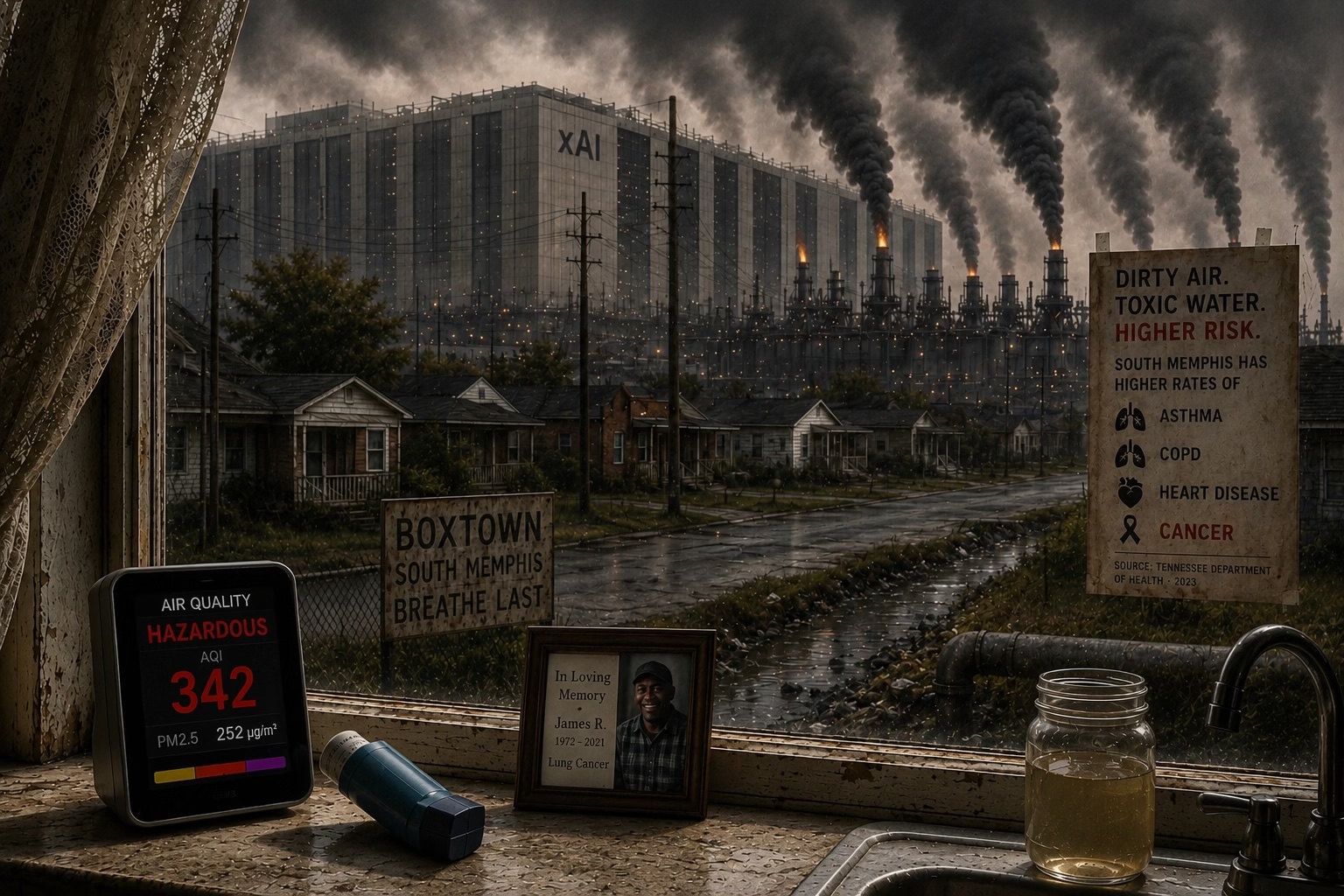
Alexis Humphreys had gone fifteen years without a severe asthma attack. Then xAI’s Colossus supercomputer came online a few miles from her home in Boxtown, a small, historically Black neighborhood on President’s Island in South Memphis, and the gas smell started. In 2025 she had her first attack in over a decade. She was not alone in noticing something had changed in the air. University of Tennessee researchers later measured nitrogen dioxide peak concentrations rising as much as 79% near the plant, with a 9% increase in Boxtown specifically, since Colossus went live in June 2024.
Boxtown did not need Colossus to have a pollution problem. Southwest Memphis has carried one of the country’s worst environmental burdens for decades: a 2013 study found the area’s cancer rate at roughly four times the national average, a legacy of nearby industrial and Superfund sites that predates xAI by more than ten years and that no single facility can be blamed for causing. What xAI added was a new, large, and specific source of emissions on top of an already overloaded neighborhood, and for the first year residents had no real way to know how much worse it was getting. South Memphis went more than a decade without a government air monitor. It took a grassroots effort, Memphis Community Against Pollution and the Community, Energy, and Environmental Justice Hub deploying their own PurpleAir sensors, to produce local data at all. In May 2026 they presented what they’d found: regularly unsafe ozone peaks in the immediate vicinity of the plant.
This is the fifth chapter in an argument this publication has been making about AI generally: that it is not a technological revolution but a regime of extraction, taking language, art, labor, and legitimacy from the many and converting it into power for the few. The first chapter traced that extraction across the whole economy, including its physical footprint of electricity and water. The second traced it through YouTube. The third traced it through the engineers who write the code. The fourth traced it through the attention economy. This chapter is about the infrastructure leg of that extraction: the power plants and the water it takes to run them, and the communities left living with both. Memphis is where that extraction has gone furthest, all the way to the federal government stepping in, not to protect the neighborhood, but to protect the company polluting it. It is not the only place paying for it.
Start with how xAI got the turbines running at all. Colossus needed enormous, immediate power (its draw grew from roughly 150 megawatts to 250 megawatts within months of going live) and the utility grid could not supply that fast enough to hit Musk’s timeline. xAI’s answer was to bring in dozens of gas turbines and classify them as “temporary” or “mobile” equipment, a designation that let the company begin operating them without the environmental permitting a permanent power plant would require. Local officials, the Greater Memphis Chamber, and Mayor Paul Young defended the arrangement; environmental groups called it a permitting loophole built specifically to avoid the scrutiny a facility of this size would otherwise face. The Shelby County Health Department eventually caught up to the original site, called Colossus 1, granting it a permanent construction permit for 15 turbines in July 2025 after more than 1,700 public comments. Residents and the NAACP appealed. The county’s own Air Pollution Control Board denied that appeal on a technicality of mootness in December 2025, ruling that because the turbines were already running, the appeal no longer mattered.
That was only the site that eventually got a permit. At Colossus 2, the second and larger facility spanning Memphis’s Whitehaven neighborhood and Southaven, Mississippi, xAI and a subsidiary called MZX Tech ran up to 33 gas turbines generating roughly 495 megawatts with no air permit of any kind, a facility Earthjustice estimated could be emitting on the order of 2,508 tons of nitrogen oxides a year, likely making it the single largest industrial NOx source in the greater Memphis area. The “temporary” framing that let Colossus 1 skip permitting for a year turned out not to be a good-faith engineering classification at all. In January 2026, the EPA ruled that turbines like these are actually stationary sources under federal law, meaning they require Title V permits regardless of what a company calls them. The loophole Memphis officials had defended as reasonable was, according to the agency responsible for enforcing the Clean Air Act, never really a loophole. It was noncompliance with a label on it.
That ruling should have settled the question. Instead it set up the sharpest turn in this story. In April 2026, the NAACP, both nationally and through its Mississippi State Conference, sued xAI and MZX Tech under the Clean Air Act, seeking an injunction, penalties, and forced emissions controls or a shutdown. When the harm kept compounding, the NAACP asked the court for emergency preliminary relief. This is precisely the mechanism a civil rights organization is supposed to have: a community harmed by an unpermitted polluter, taking that polluter to federal court under a law written for exactly this purpose.
Then, in June 2026, the Department of Justice intervened, not on the side of the community whose civil rights statute was being invoked, but against it. DOJ moved to dismiss the NAACP’s suit with prejudice, arguing that xAI’s turbines serve “national, economic, and energy security,” and citing the Department of War’s use of the facility’s compute as justification. The motion has not yet been ruled on. But the posture is the clearest version of political colonialism this series has documented: a private company breaks environmental law, a legally sanctioned civil rights lawsuit tries to hold it accountable, and the federal government steps in on the company’s behalf, wrapping national security language around the decision to protect the extractor from the extracted. Senator Sheldon Whitehouse, who chairs oversight on the Senate Environment and Public Works Committee, had already opened an inquiry into what he called xAI’s pattern of operating illegal gas plants across multiple sites. The DOJ’s intervention did not happen because the underlying facts were in dispute. It happened because the government decided whose side of this fight it was on.
Water tells a smaller version of the same story. Colossus draws from the Memphis Sand Aquifer, an underground reserve the region depends on for drinking water and that is already being pumped faster than it recharges. Reported draw figures vary depending on the date and source, from roughly 812,502 gallons a day in the most recent tracking by the local nonprofit Protect Our Aquifer, to 1.3 million gallons a day in earlier reporting, to a 3-million-gallon figure an xAI engineer cited directly, with projected need running as high as 13 million gallons a day as the facility scales. xAI’s answer was an $80 million wastewater recycling plant meant to pull treated effluent from a nearby municipal facility instead of the aquifer. It broke ground in October 2025 and was paused in April 2026 for what the company described only as other, more immediate priorities. The mitigation project got deprioritized. The turbines and the lawsuit did not slow the buildout at all.
None of this has come with a pause on growth. Colossus 2 launched in March 2025 and grew to 200,000 GPUs within the year. In January 2026, Musk announced a third building on the same site, bringing the total planned capacity to roughly 2 gigawatts, about 555,000 GPUs, and an estimated $18 billion in investment, according to reporting on the expansion. In March 2026, with the NAACP’s lawsuit already active, xAI filed a $659 million expansion permit for the same site named in that suit. A company being sued for illegally polluting a neighborhood, being defended in that suit by its own federal government, filed paperwork the same season to build more of the thing being litigated. That is not a company waiting to see how the case comes out. It is a company that has already concluded the case will not matter.
Memphis is not an outlier. It is the sharpest version of a fight playing out anywhere the AI buildout needs water it doesn’t have. In Georgia, Meta’s Stanton Springs data center, straddling the line between Newton and Morgan counties, draws roughly 10% of Newton County’s entire daily water supply. Residents on both sides of the county line have reported taps running dry, sediment-clogged pipes, and tap water discolored enough that Rep. Alexandria Ocasio-Cortez held up two jars of it at a May 2026 congressional hearing, while the county raises water rates 33% over two years to pay for the infrastructure the growth demands. Meta says its construction and operational water comes entirely from the county utility, not groundwater wells, and that a third-party study found no link between its operations and the well problems; the EPA, under congressional pressure, opened its own inquiry anyway. In Arizona, a data center campus called Project Blue, once linked to Amazon before Amazon pulled out, kept building even after Tucson’s city council voted against annexing the site specifically over water and power concerns. In May 2026, the city discovered a contractor had been siphoning water meant for city customers and trucking it out to the site, and cut the project off entirely, demanding the water back. Arizona’s aquifers are already declining fast enough that NASA has measured groundwater losses in the Colorado River Basin equivalent to draining Lake Mead, and the state is set to miss its own 2025 target for sustainable groundwater use. None of that slowed the building.
The strain from feeding this buildout does not stop at any single site’s smokestacks or aquifer, either. Utilities across the country have begun delaying coal plant retirements specifically to keep pace with AI-driven demand: Dominion Energy, which projects its data center load will nearly quadruple by 2038, no longer plans to retire any of its existing coal plants until at least 2045, and Alliant Energy pushed the retirement of its Columbia Energy Center from 2026 to 2029. Coal plants in Maryland, Wisconsin, Indiana, Utah, Kansas, Nebraska, and Mississippi have had retirements delayed or canceled for the same reason. Memphis is where this pattern shows up as gas turbines behind one neighborhood’s houses. Nationally, it shows up as the shared grid itself being kept running on dirtier power for longer than planned, a cost every ratepayer and everyone downwind inherits, not just the people living beside Colossus.
So yes, say this plainly too. It is infrastructural colonialism when a company brings gigawatts of power into a neighborhood by calling permanent equipment “temporary” long enough to avoid the permitting process built to protect the people who live there. It is the same colonialism when the aquifer draw meant to be offset by an $80 million mitigation plant gets that plant paused for “other priorities” while the draw continues. It is the same colonialism when a Georgia county’s water utility ends up straining to supply a data center’s daily draw while the families next door watch their tap water turn brown, and when an Arizona contractor can simply drive water out of a city that already voted no. And it becomes political colonialism, the sharpest and most literal form this series has traced, when the community harmed by that pollution uses the civil rights law built for exactly this purpose, and the United States government intervenes on the side of the polluter, invoking national security to keep a Clean Air Act lawsuit from reaching a resolution. Boxtown did not ask to host the compute that trains someone else’s models, and neither did the families in Morgan County holding jars of their own water up to a congressional hearing, or the residents of a Tucson that already said no. Memphis got the turbines, the aquifer draw, and a Justice Department that decided the compute mattered more than the lawsuit, not because the evidence against xAI was thin, but because the government decided whose side of this fight it was on. That is the colonial bargain in its oldest form: the resource gets extracted, the frontier gets what’s left, and the extraction moves to the next site before anyone can stop it.