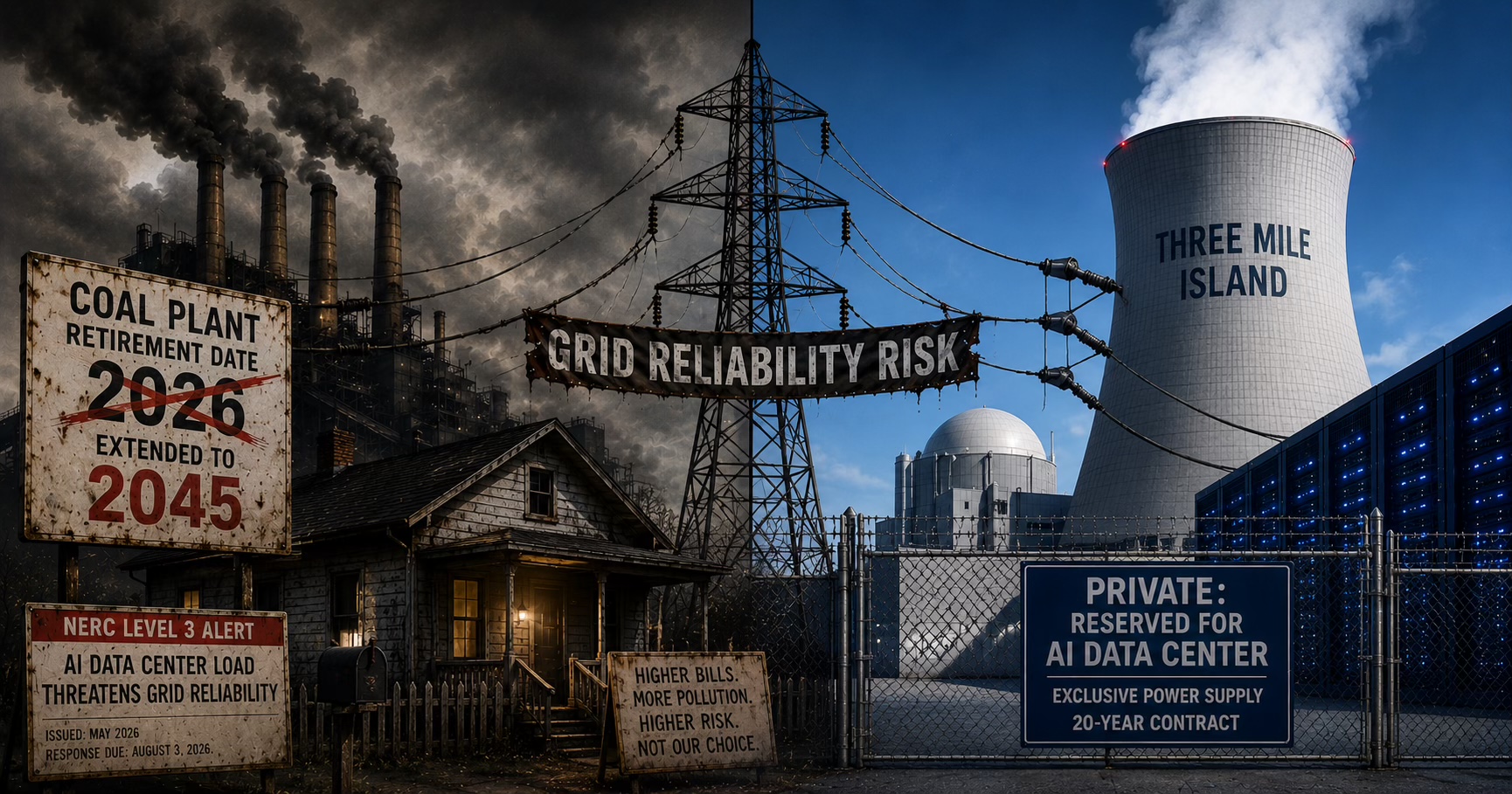
In February 2025, a single transmission fault in the eastern United States caused 1,800 megawatts of AI data center demand to disconnect from the grid at once. That is not a rounding error. It is the kind of sudden, correlated load loss that can cascade into rising frequency, tripping generators, and a wider blackout. NERC, the actual organization responsible for the reliability of North America’s bulk power system, took that incident seriously enough to issue a Level 3 alert in May 2026, one of its rarest and most urgent classifications, warning that large computational loads pose an immediate risk to grid reliability. Utilities and grid operators have until August 3, 2026 to respond. Legal analysts describe the alert as moving data centers “from emerging risks to planning obligations,” regulatory language for: this is no longer hypothetical.
This publication has spent a series of chapters arguing that AI is not a technological revolution but a regime of extraction, taking language, art, labor, and legitimacy from the many and converting it into power for the few. The first chapter traced that extraction across the whole economy. Later chapters followed it through YouTube, software engineers, the attention economy, one Memphis neighborhood’s air and water, consumer prices and electric bills, music streaming, and the industry’s own precarious finances. This chapter turns to the infrastructure underneath all of it: not one site’s turbines, not the bill, not whether the industry gets its power on time, but the shared grid itself, and what happens to it when one industry’s demand curve is allowed to bend it out of shape.
Start with the scale. Data centers account for roughly 4 percent of U.S. electricity consumption today. EPRI projects that share could reach 9 to 17 percent by 2030. Lawrence Berkeley National Laboratory puts it at 6.7 to 12 percent, 325 to 580 terawatt-hours a year. Gartner expects demand to double in that window after growing 16 percent in 2025 alone. However the estimate is built, every one of them describes the same thing: a doubling to tripling of the share of the country’s electricity going to one industry’s servers, in five years, layered onto a grid that was not built or planned for growth at this pace. Data centers alone could add roughly 125 gigawatts of U.S. electric load between 2026 and 2030, pushing overall demand growth to a rate utilities have not planned around in decades.
Utilities are responding to that pressure the only way they can on this timeline: by keeping the dirtiest plants they already have running longer than planned. Dominion Energy, which projects its own data center load will nearly quadruple by 2038, no longer plans to retire any of its existing coal plants until at least 2045. Alliant Energy pushed the retirement of its Columbia Energy Center from 2026 to 2029. Coal plants in Maryland, Wisconsin, Indiana, Utah, Kansas, Nebraska, and Mississippi have had retirements delayed or canceled for the same stated reason: preserving dispatchable capacity while AI-driven demand ramps up faster than new clean generation can be built and connected. Every year one of these plants keeps running past its planned retirement date is a year of emissions that the utility’s own climate commitments assumed would already be gone.
The federal government has gone further than letting utilities delay on their own schedule. Since 2025, Energy Secretary Chris Wright has issued a series of emergency orders blocking coal plant retirements outright, in Washington state (the Centralia Generating Station), Michigan (the J.H. Campbell plant), Colorado (Craig Station), and Florida (Stanton Energy Center), in each case overriding a retirement schedule the plant’s own owner had already set, not one sought by the utility itself. DOE’s stated justification is general grid reliability and blackout prevention, not AI specifically, and that justification is contested: state officials and reporting on the orders put the cost of keeping these plants open at $3 billion to $6 billion a year, paid by the same ratepayers this publication has already documented absorbing the AI buildout’s electricity costs directly. Whatever the department’s official framing, these orders are landing in the middle of the exact demand surge described above, keeping the oldest, dirtiest capacity on the grid precisely when that capacity is under the most strain.
Here is the part that makes this colonial rather than merely inconvenient. While the shared public grid is being asked to run on delayed coal retirements and emergency-ordered plants that were supposed to be gone, the companies driving that demand are not relying on that same grid for their own future. Microsoft signed a 20-year, $16 billion power purchase agreement to bring Three Mile Island’s Unit 1 back online, the first time a retired American nuclear plant has been revived for a single commercial customer, expected online in 2027. Amazon expanded its agreement with Talen Energy to supply up to 1.9 gigawatts of nuclear power through at least 2042, on top of a $650 million data center campus acquisition next to Talen’s own nuclear plant. Google committed to 500 megawatts from a fleet of Kairos Power small modular reactors. Analysts are calling it a nuclear arms race, and it is one only a handful of companies can afford to run. The cleanest, most reliable new power being built in this country right now is being reserved, contractually and exclusively, for the industry that is simultaneously straining the public grid everyone else depends on. The public keeps the coal plants. The industry gets the nuclear plants.
All of this assumes the anticipated demand can actually be built out. By the grid’s own regulator’s account, that is not a safe assumption. NERC’s own January 2026 Long-Term Reliability Assessment found 13 of 23 North American grid regions facing elevated or high resource-adequacy risk over the next five years; in PJM, the reserve margin is projected to fall below its own reference level starting in 2029, and in MISO, planned resource additions “do not keep pace” with demand growth and generator retirements combined. That gap is not just a projection. It is already showing up in canceled projects: Wood Mackenzie found new data center project announcements dropped 50 percent quarter over quarter at the end of 2025, and roughly a quarter of planned projects had not even secured a powering strategy before site selection, a sign the industry has been reserving land faster than it can secure the electricity to run it. In fairness, not everyone accepts NERC’s numbers at face value: Grid Strategies, an independent grid consultancy, argues NERC’s assessment overstates the risk, since it ignores a large backlog of renewable projects waiting to connect and assumes no emergency power-sharing between regions. Even Grid Strategies agrees that interconnection delays and underinvestment in transmission are real risk factors. The disagreement is about how bad it is, not about whether it is real.
That shortfall carries a cost beyond the communities and ratepayers already absorbing it, one that lands on the industry’s own stated ambitions. The United States currently holds roughly 74 percent of the world’s high-end AI compute, against China’s 15 percent, a commanding lead in chips and models. But China added 429 gigawatts of new power generation capacity in 2024 alone, more than 15 times what the United States added that year, and China is also the world’s largest producer of the transformers and electrical gear that are the actual binding constraint on the American buildout described throughout this chapter. A compute advantage that cannot be powered is not an advantage. If the gap between announced American data center capacity and the electricity to actually run it keeps widening on the timeline NERC and the industry’s own project cancellations both suggest, the country best positioned to close it may not be the one with the better model. It may simply be the one that can turn the lights on.
So yes, say this plainly too. It is infrastructural colonialism when one industry’s demand curve forces a utility to keep a coal plant running past the date its own climate commitments promised it would close. It is the same colonialism when the federal government uses emergency powers to override a plant owner’s own retirement decision, at a cost of billions passed to ratepayers who never asked for any of this. And it is the same colonialism, in its starkest form, when the very companies responsible for that strain turn around and lock up twenty-year contracts on the cleanest, most reliable power available, leaving the shared grid, and the risk of the blackout NERC is now warning about by name, to everyone else. Nobody who has never opened an AI chatbot voted to keep a coal plant open until 2045. Nobody voted to be the backup plan while Microsoft gets its own nuclear reactor. The grid was built, over decades, as public infrastructure meant to serve everyone roughly the same way. What is happening to it now is not that. It is one industry’s private growth curve, quietly rewriting the terms of a public system that has nowhere else to go.